
Pachisi, Board Game, India
Description
Pachisi is a board game that originated in ancient India (4thC
AD) and has been described as the national game of India. It is
played on a board shaped like a symmetrical cross. The player’s
beehive shaped counters move around the base on a throw of six
cowrie shells. The number of shells landing with the mouth upward
indicates the number of places to move. The name of the game comes
from the Hindu word “pachis” which means 25. 25 is the highest
score which can be thrown with the cowrie shells.
The game is for 4 players playing in 2 teams. Each player has 4
counters in red, black, yellow or green. The aim is to get all the
counters out from the centre of the cross (called the charkoni) and
move them all around the board. Enemy counters can be captured and
returned to the charkoni where they have to start again.
Pachisi is very similar to the Chinese game T’shu p’u and there
are also western equivalents called Ludo and Parcheesi.
This board is hand sewn with embroidered designs in the squares.
Notice the three crosses on each arm of the cross. These are castle
squares – they represent a safe refuge where the counters cannot be
captured by the enemy.
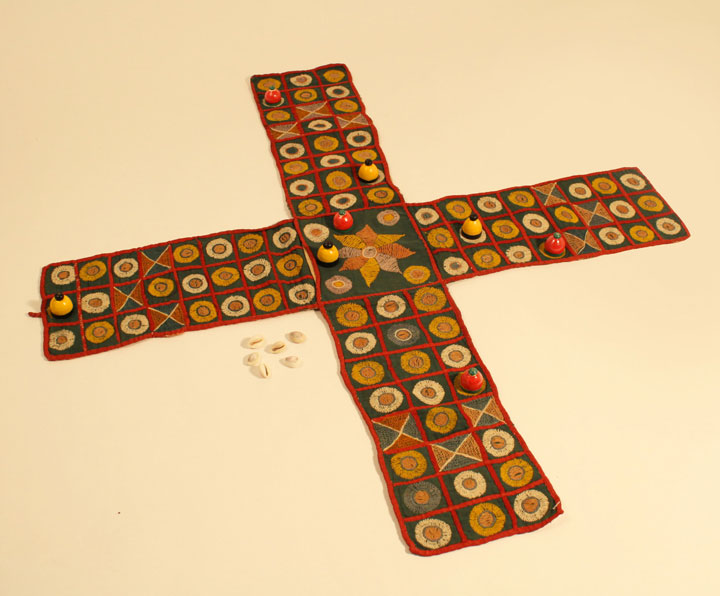
Length:80cm
Larger Image