
Carpet Watering Pot, Tudor, Replica
Description
Imagine your home without carpet on the floor or glass in the
windows.
This is what life was like in the average Tudor home. A hard mud
floor was covered with long grasses called rushes. Draughts from
the open windows would blow dirt into the house, whirling it around
furniture, people and food. Soot from candles, dust from mud, straw
and animal hide, smoke and ash from an open fire, all added to the
dirt and made the Tudor home very difficult to keep clean. And when
it came to housework, in an age long before electrical appliances,
there was no vacuum cleaner to switch into action and suck up the
dirt. It all had to be removed by hand.
Dampening dust with water doesn’t remove it, but at least it keeps
it all in one place. The Tudors solved the problem of dust
management by gently sprinkling their floors with water, keeping
dust out of the air by making it damp enough to stick among the
reed floor coverings.
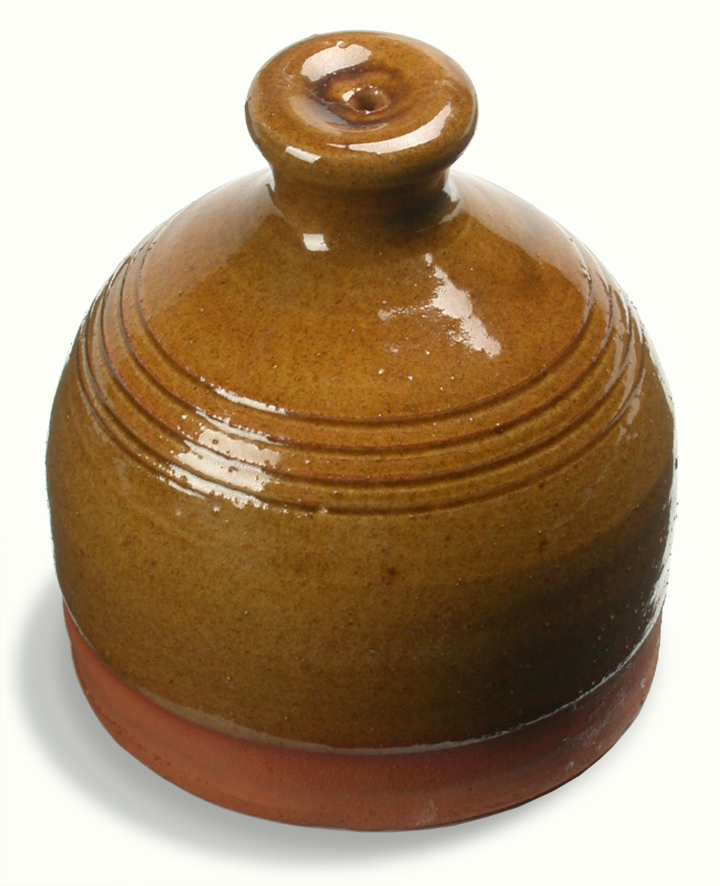
This bell-shaped watering pot is made out of hand thrown clay,
glazed, and simply decorated with hoops. The unglazed bottom of the
pot is pierced with over fifty holes. The top has a neck narrow
enough to be held between two upturned fingers, allowing the thumb
to rest over the single hole on the top of the pot.
To fill the pot you fully submerge it in water, keeping your thumb
over the top hole to create a vacuum to keep the water in. You lift
your thumb off the hole to sprinkle the water through the holes at
the bottom. The pot had to be light enough to be carried by one
hand, even when full of water.
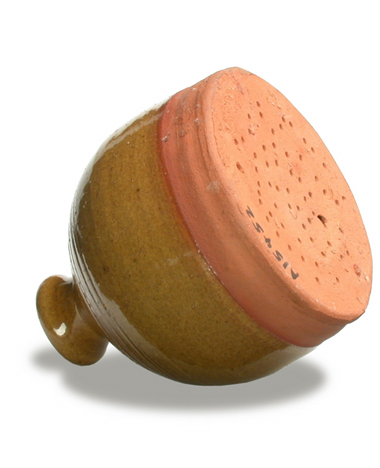
Alternative view
Height:11cm Diameter:10cm
Read More
Throughout history, men, women and children have built places to
live in and created homes. As lifestyles, materials and
technologies have changed, so have houses, and the methods we use
to keep them clean.
The average Tudor house was created out of a timber frame, filled
in with a material called daub. Daub is a mixture of cow dung,
clay, chopped straw and lime. This made the walls quite dusty to
touch. The roof was thatched with straw, and dust from the straw
would drift into the living spaces. The main living room was called
the hall; it had an earth floor with an open fire burning in the
centre of the room. Smoke rose from the fire, and was drawn towards
the ceiling by a hole in the roof. In larger houses the fire was
set in a fireplace in the wall. The fireplace had a closed tunnel
called a chimney to remove smoke from the room. The floor was
covered with rushes to keep down the dirt. When these got too
dirty, they were swept out and burned, and replaced by new ones.
Sometimes herbs were strewn on the floor to create a good
smell.
Many Tudors used their homes as business premises, to make
products, to sell and to buy, so workshops and visiting customers
would be considered a normal part of life. There were no taps and
sinks. Water was hauled up from a well.
A Tudor house quickly got dirty and, as there was no electricity,
all cleaning had to be done by hand. Bedding, linen and clothes
were washed twice a year. Rooms were swept out, and dust kept down
by sprinkled water and rushes. Standards of cleanliness were not as
high as they are today, as living conditions were more challenging.
Tudor men and women had to spend more time growing and preparing
food, making clothes and domestic products, and looking after
animals. They had little spare time for leisure, and time spent on
cleaning was not a priority.
Height:11cm Diameter:10cm
Larger Image