
Vaporiser, Victorian, Original
Description
The vaporiser is presented in a sturdy cardboard box. An image of
the product is printed on the box with instructions on its use.
Inside the box an information sheet gives further advice and
instruction.
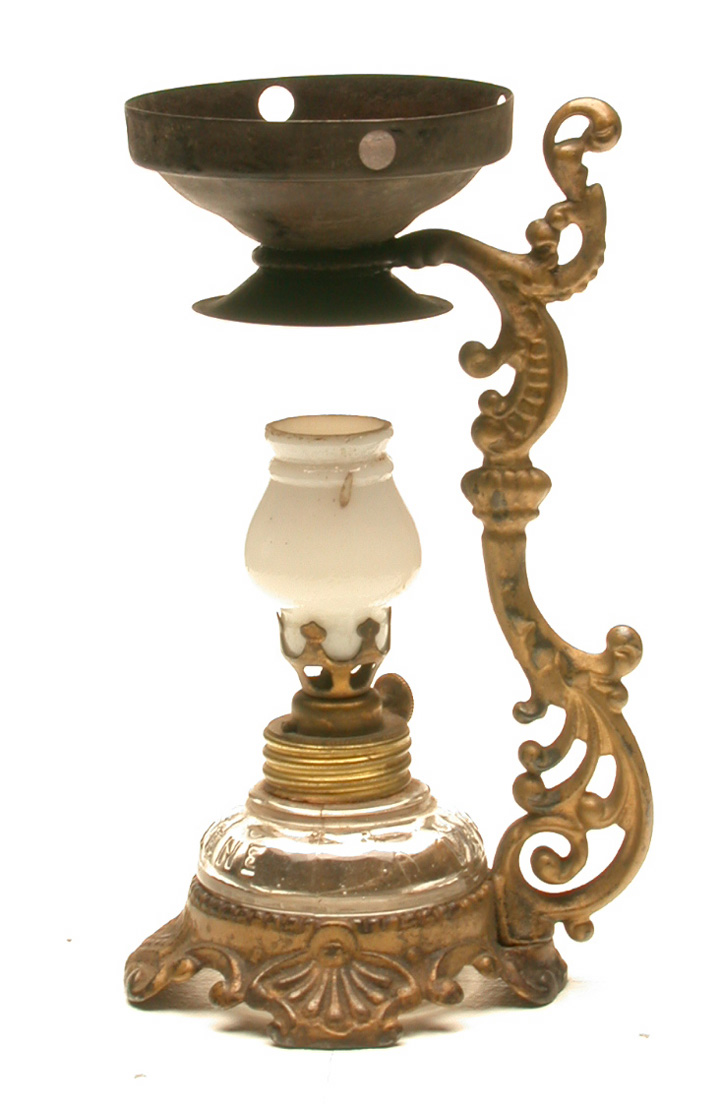
The vaporiser has a metal base, and an elaborate, decorative arm
that rises from one side of the base to form a holding ring for a
metal cup. There is a tiny oil lamp between the base and the
holding ring. This lamp has a glass bowl to hold the oil. Attached
to the oil bowl is an opaque glass shade. A wick or length of
plaited fabric is coiled in the oil bowl. A turning mechanism
raises one end of the wick out of the bowl, where it can be lit.
The oil has made it inflammable. The shade prevents the flame from
being blown out, and directs the heat to the base of the cup. The
heat from the lamp warms up the cup, which was filled with a
solution of cresolene. The warm cresolene would then evaporate into
the room. Cresolene was believed to have medicinal properties that
would soothe and even cure diseases such as croup and whooping
cough.
Height:16cm
Read More
By the end of the nineteenth century it was acknowledged that
diseases such as Diphtheria, Whooping Cough, and Croup were
contagious, and that infection was carried from person to person by
coughing, spitting, kissing, sneezing, and indirectly through
towels, napkins and handkerchiefs. Diphtheria is a bacterial
disease of the tonsils, noise and larynx. It is characterised by
lesions marked by greyish membranes and surrounding inflammation.
Whooping Cough is also a bacterial infection, resulting in violent
coughing fits and a characteristic whooping noise as a sufferer
gasped for air. Before an immunisation programme in the 1940s,
Whooping Cough had a high mortality rate in young children. Croup
describes a group of related conditions involving the inflammation
of the upper airways. It has a characteristic barking cough.
A vaporiser was a device designed to clean and clear the air for a
person suffering from an infectious disease, especially one
relating to the nose and throat. Liquid cresolene was heated in the
cup, and it would evaporate into the air of the sick room, or
around the patient. The patient would inhale the cresolene in the
air, which would move through their nose, throat and lungs,
combating bacteria described as ‘this dreaded enemy of the human
race.’ The steam would also moisturise mucous membranes, cleaning
mucous away, and allowing the patient to breathe and sleep more
easily.
Information provided with the product includes testimonials sent to
the company from people praising the worth of the product. The
testimonials indicate how highly the Vaporiser was valued.
The matron of Morris County Children Home in New Jersey wrote ‘We
had about forty cases of Whooping Cough; the worst ones we put in
one room and used the Vaporiser. There are only two or three who
cough at all now.’
The resident physician from the Soldiers and Sailors Orphan Home
wrote ‘My colleague did not use the Vaporiser. When I came on duty
I found two cases well established and the children much exhausted.
The Vaporisers were started, and after forty eight hours the
coughing had ceased, no more whooping or vomiting…the epidemic
was at an end.’
It was recommended that the Vaporiser be used in an enclosed space
to allow the patient to get the maximum benefit from its
properties. Home sick rooms, hotels, hospitals, water closets,
stables and cellars were suggested places to use a Vaporiser.
Cresolene had beneficial properties for rabbits, horses and dogs,
and would drive away lice, mosquitoes, ants, cock roaches flies and
ants.
Vaporisers are still sold and recommended for use today, and are
especially efficient for helping young children with coughs and
colds get a good nights sleep. An ingredient currently marketed as
Vick has replaced Cresolene.
Height:16cm
Larger Image
Moving Object
The vaporiser is presented in a sturdy cardboard box. An image of
the product is printed on the box with instructions on its use.
Inside the box an information sheet gives further advice and
instruction.
The vaporiser has a metal base, and an elaborate, decorative arm
that rises from one side of the base to form a holding ring for a
metal cup. There is a tiny oil lamp between the base and the
holding ring. This lamp has a glass bowl to hold the oil. Attached
to the oil bowl is an opaque glass shade. A wick or length of
plaited fabric is coiled in the oil bowl. A turning mechanism
raises one end of the wick out of the bowl, where it can be lit.
The oil has made it inflammable. The shade prevents the flame from
being blown out, and directs the heat to the base of the cup. The
heat from the lamp warms up the cup, which was filled with a
solution of cresolene. The warm cresolene would then evaporate into
the room. Cresolene was believed to have medicinal properties that
would soothe and even cure diseases such as croup and whooping
cough.