
Woman’s Headdress, Medieval, Replica
Description
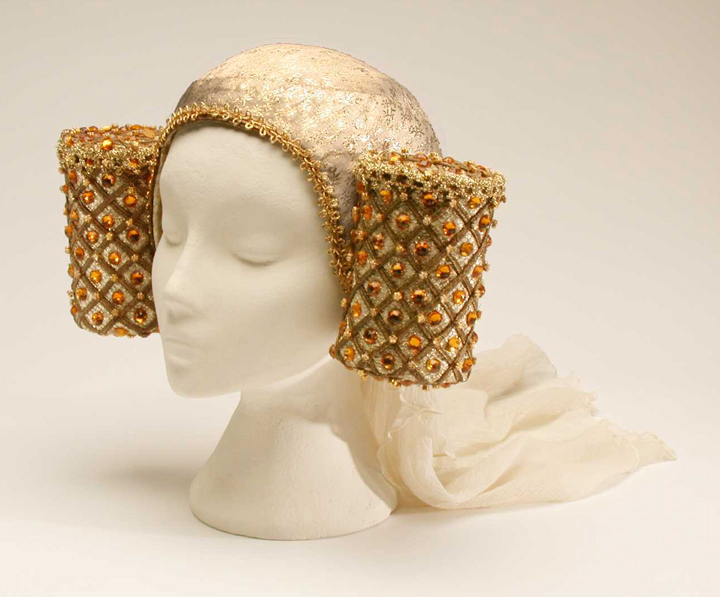
In the Middle AgesAnother term for the period from 11th to 15th century. this style of head-dress was worn by noblewomen. This head-dress is a replica. It is in three parts – the veil, crespinesCrespine – an ornamental hairnet, worn in medieval times. (hairnet) and golden cap. The crespines are made of gold braid with small gold flowers, and the netting is decorated with glass beads. Gold lace trims the border around the top edge.
The crespines are attached to a golden cap that fits snugly on the head. This cap is not typical mediaeval headwear, the crespines would normally have been attached to a narrow band of material or metal that sat on the head like a crown. This was called a filletA stiffened band of linen or silk which was worn round the head, sitting above the forehead. or coronetA narrow crown. and it would have extensions on either side forming the top of the crespines.
Flattering veils that framed the face were very popular in the Middle Ages. This veil is semi-circular in shape, with the straight edge falling on either side of the face and the curved edge brushing the top of the shoulders. It is made of two layers of white translucent material; one is shorter than the other and stops at the back of the neck while the other drops below. The veil is attached to the back of the cap, but in the Middle Ages it would have been secured by the fillet.
Read More
The use of crespinesCrespine – an ornamental hairnet, worn in medieval times. in the 14th century, was a daring fashion because until then women’s hair had been hidden from view beneath veils and wimpleA head-dress, covering the neck and the sides of the face. A length of material was draped across the throat below the chin, with the ends pinned to the hair on the crown of the head and hidden beneath a veil. It fell out of fashion in the 16th century. Nuns are associated with wearing wimples.s. With the appearance of the crespine the hair came into view. The crespine allowed for a number of different hair arrangements and its shape changed with fashion. Women could plait their hair and twist the plaits around the head, or roll them up into spiral ‘earphones’. Alternatively they could gather the hair in a bun at the back of the head. The crespine was popular with women from all walks of life. Those worn by noblewomen were made of silk cord and studded with jewels or metal at the intersections of the mesh. Less wealthy women had crespines made of coarse thread.
Fashion in women and men’s clothes developed rapidly in the 14th century. There was a change in the outline of the figure, and a greater distinction between male and female dress appeared. Settled political times and increasing trade with countries abroad meant that a great variety of expensive fabrics became available. Lavish decorations – large floral and geometric patterns, heraldic designs and jewelled embroidery – became popular.
King Richard II (1377-99) led the trend for extravagant outfits. Men of the time wore padded doubletA man's close-fitting jacket with or without sleeves.s, cod-pieceA bag covering the male genitals, attached to trousers.s and close-fitting tunicA close-fitting jacket.s, and there was a wide variety in types of hat. Women wore gowns that were close fitting to the waist and flared out from the hips. Sleeves were long and tight, necklines low and wide. The simple fitted dress served to set off the elaborate head-dresses and veils, which became increasingly fashionable and varied in the second half of the 14th century.
A head-dress like this would have been worn for special occasions and at formal dinners. In medieval timesIn Britain, the period from the Norman invasion in 1066 to around 1460. women stayed in the home, cooking, looking after children and doing housework. Wealthy ladies oversaw the work of their servants. During the day they would wear plain dresses and veils. But for events like tournaments, banquets and visits with other noble families, they would dress up in all their finery.
Larger Image
Glossary
- Cod-piece
- A bag covering the male genitals, attached to trousers.
- Coronet
- A narrow crown.
- Crespines
- Crespine – an ornamental hairnet, worn in medieval times.
- Doublet
- A man’s close-fitting jacket with or without sleeves.
- Fillet
- A stiffened band of linen or silk which was worn round the head, sitting above the forehead.
- Medieval Times
- In Britain, the period from the Norman invasion in 1066 to around 1460.
- Middle Ages
- Another term for the period from 11th to 15th century.
- Tunic
- A close-fitting jacket.
- Wimple
- A head-dress, covering the neck and the sides of the face. A length of material was draped across the throat below the chin, with the ends pinned to the hair on the crown of the head and hidden beneath a veil. It fell out of fashion in the 16th century. Nuns are associated with wearing wimples.