
Boy’s Skull Cap, Rajasthan
Description
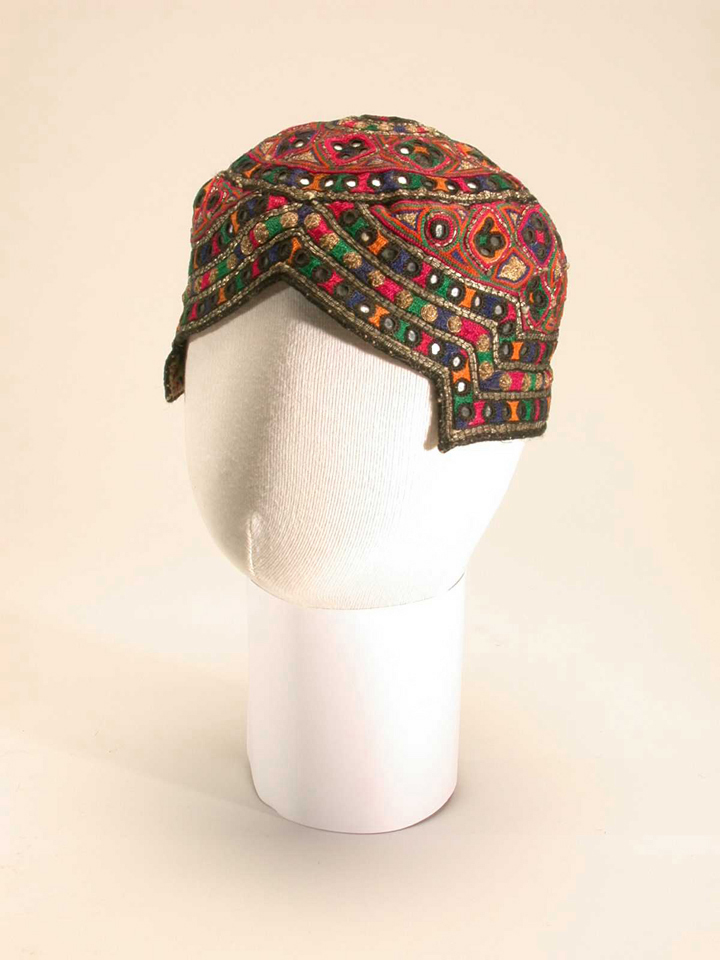
This is a boy’s skull capClose-fitting headwear which follows the shape of the skull. It has a crown and border but no brim. from RajasthanA province in western India with a tradition of mirrored embroidery. in western India. It is practical as it covers the wearer’s head from the harsh rays of the hot desert sun. It is decorative as colours and mirrors are visually dramatic against the dun colours of the region. And it has religious significance – in the IslamicIslam – The religion founded by the Prophet Muhammad in Arabia in the 7th century AD. Muslims believe in one god and show this by professing their faith and praying five times a day. Muslims fast during the month of Ramadan, and should perform the pilgrimage to Mecca once in their lifetime. Their holy book is the Qu'ran. Muslim men often wear caps and hats to cover their heads. faith believers cover their heads, especially during prayer.
This cap is cotton and is colourfully embroidered with mirrors stitched into the design. Orange, yellow, green, pink, blue and black floss silks and shiny gold thread have been used in the embroidery. The embroidery was done by hand, as can be seen on the inside of the cap. The cap has an arched shape at the front, which frames the forehead. This arch is similar to the shapes that appear in Islamic art and architecture.
Read More
The IslamicIslam – The religion founded by the Prophet Muhammad in Arabia in the 7th century AD. Muslims believe in one god and show this by professing their faith and praying five times a day. Muslims fast during the month of Ramadan, and should perform the pilgrimage to Mecca once in their lifetime. Their holy book is the Qu'ran. Muslim men often wear caps and hats to cover their heads. religion decrees that both MuslimThe name given to followers of the Islamic religion. men and women should dress modestly and cover their heads. The usual dress is shalwar kamiz – a loose tunic over baggy trousers. Men wear skull capClose-fitting headwear which follows the shape of the skull. It has a crown and border but no brim.s, hats or turbanHead-covering consisting of a long piece of cloth wound around the head.s. Women wear headscarves. The rules are relaxed for children, so they do not need to cover their heads at all times. But sometimes the boys wear caps and girls wear headscarves like the adults. A Muslim boy would wear this cap to pray. Muslims cover their heads when praying whether they do so in a mosque, at home or in the street. They pray five times a day and kneel on a prayer mat that points towards the holy city of Mecca.
Mirrored embroidery decorates the costume of people in the desert regions of Western India and Pakistan. It is common in the Indian provinces of RajasthanA province in western India with a tradition of mirrored embroidery. and GujeratA province in western India with a tradition of mirrored embroidery., and in the Pakistani provinces of SindA desert province in southern Pakistan with a tradition of mirrored embroidery. and BaluchistanA desert province in western Pakistan with a tradition of mirrored embroidery.. The embroideryDecorative sewing on cloth or canvas. varies from region to region with each community having its own particular style of needlework, range of colours and repertoire of stitches. The decoration on boys’ caps usually follows the same tradition as that of women’s costumes. So the embroidered patterns on boys’ caps may also be seen on skirt borders.
Embroidery is the work of women, both young and old and the tradition is passed down through the generations. A girl is taught to embroider when she reaches school age. Over the years she will produce a collection of embroidered hangings, quilts, blouses, pillow covers, headscarves and children’s caps. These items form part of her dowryThe property a woman brings to her husband when she gets married., which might also include a gift for her husband such as a turbanHead-covering consisting of a long piece of cloth wound around the head. cloth or even an embroidered rifle cover. The bride will take these things to her new home when she gets married.
The embroidery is highlighted by the sparkle of small mirrors called shisha. In most cases, as here, the mirrors are in fact small pieces of micaA mineral which forms glittering scales like mirrors and can be found in the deserts of India and Pakistan.. Mica is a mineral made up of talc-like crystals. These crystals are laid down as thin sheets on rocks. The glittering scales can be peeled off easily by locals, or bought cheaply in sheets or as loose flakes called ‘splittings’. Mica has the same light reflecting properties as glass but is lighter and easy to work with. It is used not only in garments but also placed in the walls inside houses where it reflects the light like a glitter ball.
Skull caps and other garments in Rajasthan are popular souvenirs with tourists for their mirrors, colours and embroidery. Rajasthani crafts also include puppet making, sculpted stonework on palaces and temples, tie-dyed and block-printed textiles plus small carved wooden chests and boxes.
Larger Image
Glossary
- Baluchistan
- A desert province in western Pakistan with a tradition of mirrored embroidery.
- Dowry
- The property a woman brings to her husband when she gets married.
- Embroidery
- Decorative sewing on cloth or canvas.
- Gujerat
- A province in western India with a tradition of mirrored embroidery.
- Islamic
- Islam – The religion founded by the Prophet Muhammad in Arabia in the 7th century AD. Muslims believe in one god and show this by professing their faith and praying five times a day. Muslims fast during the month of Ramadan, and should perform the pilgrimage to Mecca once in their lifetime. Their holy book is the Qu’ran. Muslim men often wear caps and hats to cover their heads.
- Mica
- A mineral which forms glittering scales like mirrors and can be found in the deserts of India and Pakistan.
- Muslim
- The name given to followers of the Islamic religion.
- Rajasthan
- A province in western India with a tradition of mirrored embroidery.
- Sind
- A desert province in southern Pakistan with a tradition of mirrored embroidery.
- Skull cap
- Close-fitting headwear which follows the shape of the skull. It has a crown and border but no brim.
- Turban
- Head-covering consisting of a long piece of cloth wound around the head.