
Makishi Figure, Zambia
Description
This figure represents an ancestral spiritThe spirit of someone who is long dead. known as a
Makishi. It was made by the ChokweA nation of African people who live in parts of Angola, the Democratic Republic of Congo and Zambia. people who live in the
south-west region of Africa in parts of Angola, the Democratic
Republic of Congo and Zambia. This figure was probably made quite
recently for sale to tourists. It is not for “traditional” use and
does not resemble any one character. Instead, it has some the
features of two ancestral spirits – Katotola and Mupala.
The Chokwe people believe that the spirits of people who died long
ago can influence their lives. Men dress up as these spirits,
putting on masks and fringed skirts, painting their faces and
carrying sticks or weapons. This figure is brandishing two sticks
called kukuwaSticks that symbolize the bones of ancestors. They are played by beating the sticks together and are used by masked characters and boys in the initiation camp, at ceremonies and events., which symbolise the bones of ancestors. It
appears to be dancing and playing the sticks. The patterns on the
body, the fringed skirt and the mask of the Makishi figure are like
those worn by a man dressed for his part in an initiation
ceremonyRituals performed during the change from childhood to adult status, where adolescents are educated in the duties of adulthood and may undergo circumcision.. In this traditional, secret ceremony, teenage boys
are circumcisedThe removal of all or part of the foreskin. In many cultures circumcision forms part of a ceremony initiating boys into adult life. and learn about adult life.
The figure is made from woven strips of plastic over a wire frame.
It is surprisingly light in weight.
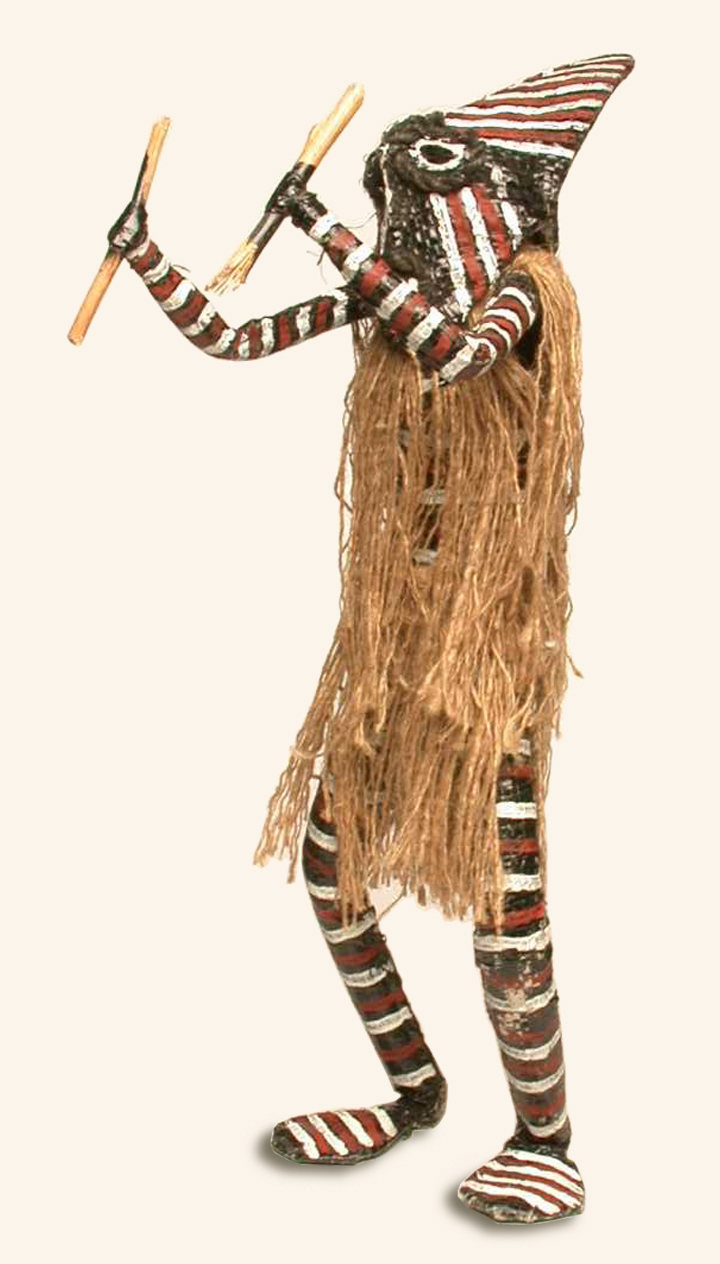
Height:42cm
Read More
This figure combines the features of two ancestral spiritThe spirit of someone who is long dead.s /
masked characters – Katotola and Mupala. Katotola plays the
kukuwaSticks that symbolize the bones of ancestors. They are played by beating the sticks together and are used by masked characters and boys in the initiation camp, at ceremonies and events. sticks in ceremonies. The sticks symbolize the bones
of the ancestors. Katotola beats the sticks together and performs a
rhythmic dance. Mupala’s headdress is attached to the back of the
mask and rises up from the head in a curved arch. It is painted red
and white, though the design is different to the figure’s striped
pattern. In fact the painted stripes on this figure’s body are
unusual in that they are not traditional ChokweA nation of African people who live in parts of Angola, the Democratic Republic of Congo and Zambia.
markings.
Both of these masked characters take part in the mukanda, the
Chokwe initiation ceremonyRituals performed during the change from childhood to adult status, where adolescents are educated in the duties of adulthood and may undergo circumcision. for males. When boys are around
13-16 years old, they go through a series of rituals and ceremonies
to equip them for adult life. At the beginning of the mukanda, men
representing Mupala and Katotola and other masked characters arrive
in the village, striking their sticks together and crying ‘we-he
we-he’ to announce their arrival in the village. At the sound of
the beating sticks and shrieking spirits, women and children flee
into their dwellings as they are not allowed to take part in the
ceremony. Then the masked figures seek out those boys who are ready
to be initiated, and lead them to a secret camp in the forest.
There the boys are circumcisedThe removal of all or part of the foreskin. In many cultures circumcision forms part of a ceremony initiating boys into adult life. and learn the skills they
need for adult life. Young boys play the kukuwa sticks inside the
initiation camp, beating one against the other during sunrise and
sunset to honour the ancestors.
Men representing AkishiAncestral spirits – the spirits of dead people that return to the world of the living to guide, assist, protect and even educate members of a community on important occasions. (ancestral spirits) stay with the
boys in the camp and act as their guardians and teachers. There is
an aura of great secrecy around the camp. The boys are not allowed
to come into contact with people outside the camp. Akishi go to the
village to collect food. When the boys leave the camp to hunt or
wash they are always accompanied by a masked figure so that other
people do not approach them.
Height:42cm
Larger Image
Moving Object
This figure represents an ancestral spiritThe spirit of someone who is long dead. known as a
Makishi. It was made by the ChokweA nation of African people who live in parts of Angola, the Democratic Republic of Congo and Zambia. people who live in the
south-west region of Africa in parts of Angola, the Democratic
Republic of Congo and Zambia. This figure was probably made quite
recently for sale to tourists. It is not for “traditional” use and
does not resemble any one character. Instead, it has some the
features of two ancestral spirits – Katotola and Mupala.
The Chokwe people believe that the spirits of people who died long
ago can influence their lives. Men dress up as these spirits,
putting on masks and fringed skirts, painting their faces and
carrying sticks or weapons. This figure is brandishing two sticks
called kukuwaSticks that symbolize the bones of ancestors. They are played by beating the sticks together and are used by masked characters and boys in the initiation camp, at ceremonies and events., which symbolise the bones of ancestors. It
appears to be dancing and playing the sticks. The patterns on the
body, the fringed skirt and the mask of the Makishi figure are like
those worn by a man dressed for his part in an initiation
ceremonyRituals performed during the change from childhood to adult status, where adolescents are educated in the duties of adulthood and may undergo circumcision.. In this traditional, secret ceremony, teenage boys
are circumcisedThe removal of all or part of the foreskin. In many cultures circumcision forms part of a ceremony initiating boys into adult life. and learn about adult life.
The figure is made from woven strips of plastic over a wire frame.
It is surprisingly light in weight.
Glossary
- Akishi
- Ancestral spirits – the spirits of dead people that return to the world of the living to guide, assist, protect and even educate members of a community on important occasions.
- Ancestral spirit
- The spirit of someone who is long dead.
- Chokwe
- A nation of African people who live in parts of Angola, the Democratic Republic of Congo and Zambia.
- Circumcised
- The removal of all or part of the foreskin. In many cultures circumcision forms part of a ceremony initiating boys into adult life.
- Initiation ceremony
- Rituals performed during the change from childhood to adult status, where adolescents are educated in the duties of adulthood and may undergo circumcision.
- Kukuwa
- Sticks that symbolize the bones of ancestors. They are played by beating the sticks together and are used by masked characters and boys in the initiation camp, at ceremonies and events.