
Woman’s Bonnet, Victorian, Replica
Description
If you have a hat that ties with a ribbon below the chin, you have a bonnet!
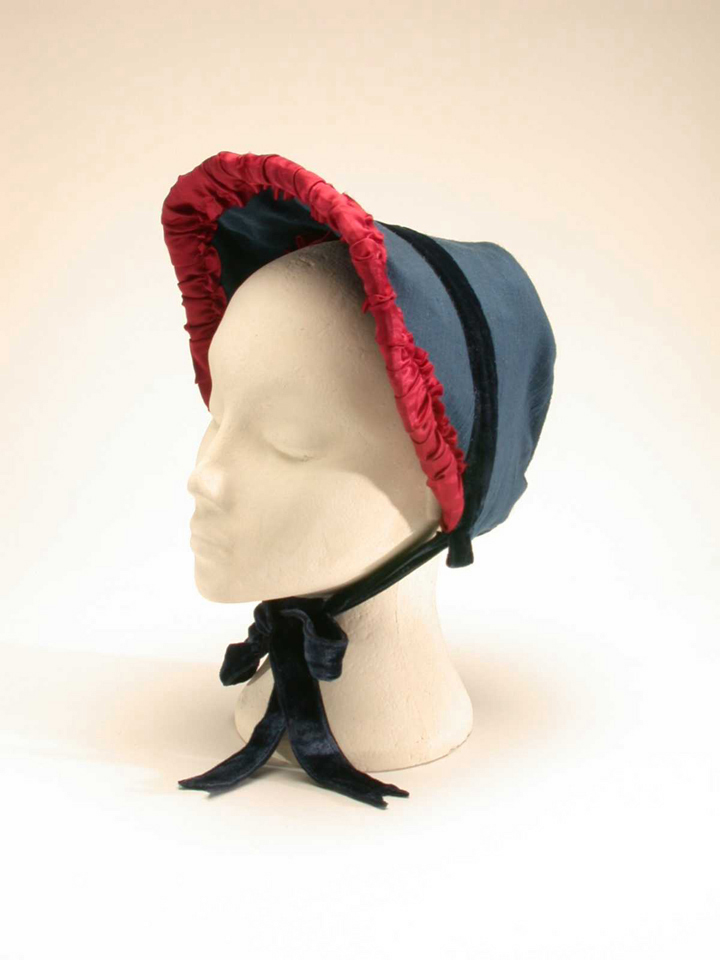
This blue bonnet is a replica of one worn in Victorian times. It is made of three pieces of material – one piece covers the back of the head, one goes over the crownThe highest or central curved part of the head or hat. and round the sides of the face and the other piece is the brim. It is quite plain and is for a maid or other working woman. The dark colour and the velvet tie tell us that it would have been a winter bonnet.
Rose satin trim is ruchedRuche – a strip of pleated or frilled lace or ribbon used to decorate clothes. around the brim of the bonnet framing the face at the front but there are no fancy additions such as feathers or lace, which rich ladies wore. The bonnet is close-fitting and the brim is shallow so that only the ears and back of the head are hidden from view.
The bonnet was the most popular item of women’s headwear in the nineteenth century. During the early Victorian period, from 1837-1860, it was considered to be the only correct form of outdoor head covering. Every woman wore it, from servants to royalty. The bonnet continued to be worn until the end of the 19th century when other hat styles came into vogue.
Read More
Bonnet styles varied throughout the 19th century, with the material, the shape, and the size and angle of the brimThe projecting edge of a hat. changing according to fashion. Coal scuttle, sugar-scoop and poke bonnetAlso called the coal scuttle or sugar scoop due to the shape of the bonnet's brim, which curves over the wearer's face, hiding the profile. were some of the names given to an early style where the wearer’s face was tantalisingly hidden from view by a long curved brim. A contrasting style was the cottage bonnet where the crownThe highest or central curved part of the head or hat. formed a continuous line with the short brim, and it either closed around the face demurely or opened out to reveal the front of the head.
Bonnets followed different styles depending on the occasion. For special occasions, which meant dressing up in finery, the bonnets would be made of silks or rows of lace or folds of gauze. Plainer bonnets were worn for everyday outings. The Easter bonnet was a brand-new spring hat trimmed with flowers and worn to church on Easter Sunday.
Styles also changed to suit the seasons. The sunbonnet was made of cotton or straw and had a large brim to shade the face from the summer sun. This was very important in an age where a pale complexion was much admired. An alternative to the sunbonnet was to wear an extra brim called an ‘uglyAn extra brim made of semicircular cane hoops, covered with silk and worn round the front of the bonnet, to shade the face from the sun.‘. It was made of semicircular cane hoops, covered with silk and worn round the front of the bonnet like a canopy. On the other hand, winter bonnets were designed to keep the wearer warm and were made from velvet, and sometimes trimmed with fur.
Sometimes trimmingsOrnamentation or decoration of clothing. could be elaborate and even bizarre – small birds, beetles or fruit and vegetables occasionally featured on the most striking hats. It was more usual for bonnets to be trimmed with ribbons, feathers or flowers, usually pinned to the sides. The inside of the brim was seen as important as the outside. It was often lined, and sometimes decorated with frills of lace, velvet, netA fabric with an open mesh. or tulleA soft fine silk net for veils and dresses. The name comes from the place in France, Tulle where it was first made..
Widows wore black crepe bonnets draped with a heavy veil. In 1861 Queen Victoria went into mourning when her husband Albert died, and she wore black for the rest of her life. At her Golden Jubilee celebration in 1887, Victoria refused to wear a crown for the royal procession. Instead, she wore a bonnet and long dress.
The bonnet went out of fashion towards the end of the 19th century, by which time it was mainly associated with spinsters and widows. However it continues to be worn by women in the Salvation ArmyAn international Christian organisation founded in 1865 in London by William Booth. Members wear uniform, which for women includes a bonnet..
Larger Image
Glossary
- Brim
- The projecting edge of a hat.
- Crown
- The highest or central curved part of the head or hat.
- Net
- A fabric with an open mesh.
- Poke bonnet
- Also called the coal scuttle or sugar scoop due to the shape of the bonnet’s brim, which curves over the wearer’s face, hiding the profile.
- Ruched
- Ruche – a strip of pleated or frilled lace or ribbon used to decorate clothes.
- Salvation Army
- An international Christian organisation founded in 1865 in London by William Booth. Members wear uniform, which for women includes a bonnet.
- Trimmings
- Ornamentation or decoration of clothing.
- Tulle
- A soft fine silk net for veils and dresses. The name comes from the place in France, Tulle where it was first made.
- Ugly
- An extra brim made of semicircular cane hoops, covered with silk and worn round the front of the bonnet, to shade the face from the sun.