
Tooth Powder, Edwardian, Original
Description
Keeping your teeth and gums clean is a healthy thing to do as it
helps avoid disease and decay. Cleaning your teeth also keeps your
breath fresh. People have used different ways of keeping their
teeth clean over the centuries. Today we use toothbrushes and
toothpaste.
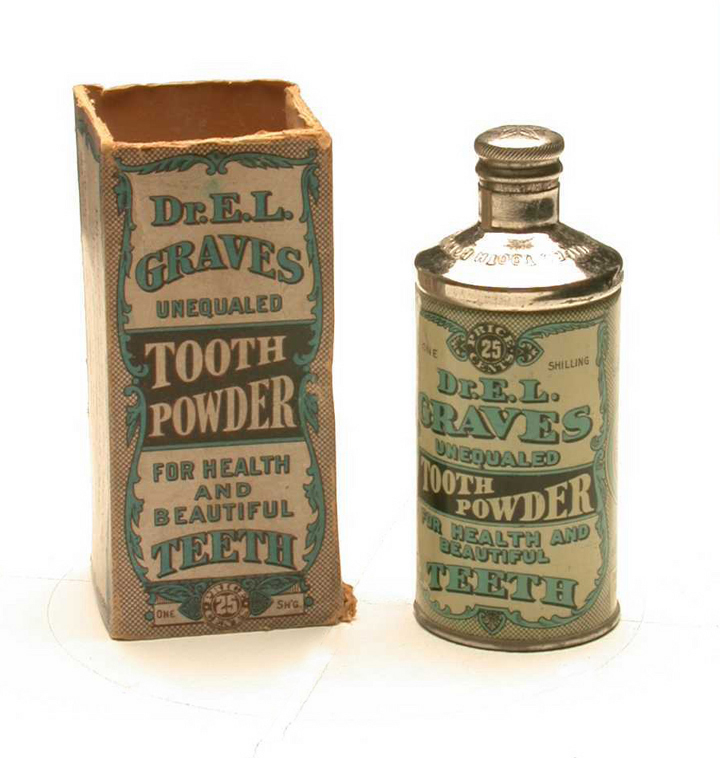
This metal can contains toothpowder. Its screw top twists open to
reveal a small hole through which the powder was poured. The
toothpowder would have been sprinkled on a brush, and used as we
now use toothpaste. A printed metal label has the words “Dr E. L.
Graves Unequalled Tooth Powder for Health and Beautiful Teeth”.
These words are also embossed on the can. Two prices are printed on
the label – one shilling and 25 cents – indicating that the powder
was sold in both Britain and the United States of America.
The tooth powder can is packaged in a cardboard box and was
produced from 1906-1916. The box is printed with similar
information and also gives advise on “The Care Of The Teeth”, and
“Directions” for using the powder. The manufacturer, E. L Graves,
Chicago, and the name of the British agents, Thomas Christy, with
their London address are on one side of the box.
Height:10cm
Read More
A commercial product, such as this can of tooth powder in its
cardboard box, shows us that the Edwardians cared about their
teeth in a similar way to us today. The text on the box gives very
precise instructions, but with a slightly different use of
language:
The teeth should be examined by the dentist at least once a
year and cleaned if necessary, and should receive such other
attention required.
It is essential that all foreign matter be removed from between the
teeth. The quill makes the best pick.
Stains and tarter should be kept off the teeth from early
childhood. The cavities of decay should be filled when small to
accomplish the best result.
As soon as possible children should be instructed in the proper use
of brush and powder, so that correct habits of cleanliness will be
early established. Their teeth are usually neglected until much
harm is done. In most cases irreparable injury has been caused, as
decay and premature loss of temporary teeth or decay and loss of
the first, largest and most important of the permanent teeth, or
unhealthy and unsightly irregularities have resulted: with proper
care and the advice of a skilful and painstaking dentist would
surely have been prevented.
A commercial product will also have to sell itself, so the
packaging will be trying to compete with other products on the
shelf for our attention. Looking at the design of the packaging can
tell us about the graphics, and advertising style of the period.
The tooth powder was imported from the E.L Graves Tooth Powder Co.
in Chicago, and distributed in Britain by Thomas Christy & Co.
in East London.
The development of toothpaste began as long ago as 300BC in India
and China. The Egyptians made tooth powder from a mixture of
powdered ashes of hooves of oxen, myrrh, pumice and powdered and
burned eggshells. The Greeks and Romans were the first to bind
loose teeth together, and support artificial teeth with fine gold
wire. Tooth powder was available in Britain from the late 18th
century onwards, and often contained dangerous and abrasive
materials such as brick dust and cuttlefish. GlycerineA thick sweet colourless liquid made from fats and oils. was
added to tooth powders to make them more palatable, and
boraxA white powder used for making glass, enamels and detergents. was used to give a cleansing, foaming effect.
In 1896 Colgate Dental Cream was the first to be packaged in the
collapsible tubes that we are familiar with today. Toothpaste
manufactures are now obliged to list the ingredients of their
product. Dr E.L Graves declines to tell us the ingredients of his
unequalled tooth powder.
Height:10cm
Larger Image
Glossary
- Borax
- A white powder used for making glass, enamels and detergents.
- Glycerine
- A thick sweet colourless liquid made from fats and oils.