
HMV Table Top Radiogram, 1950s, Original
Description
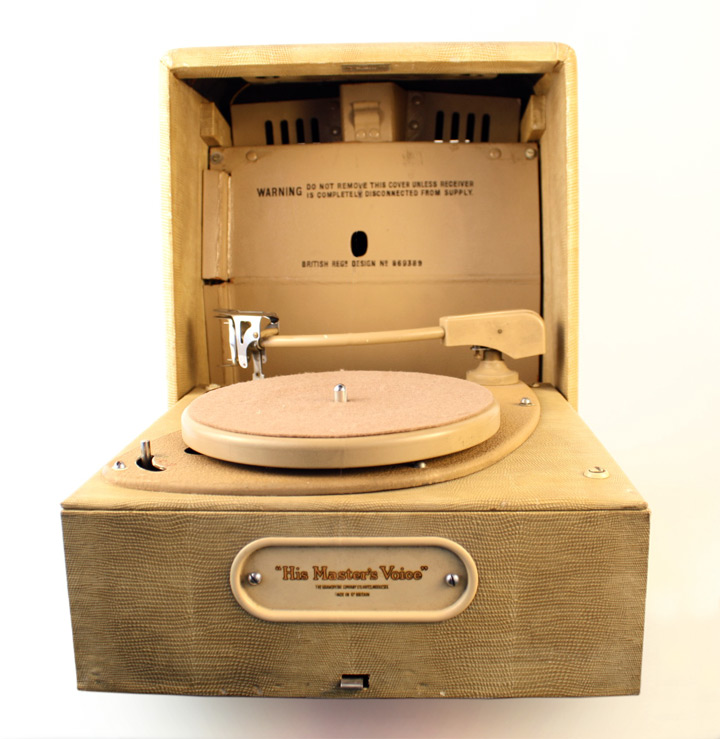
This looks, at first, like a rather chunky radio but when you
push on a lever at the back a little turntable lowers down and you
can see that it is also a record player. The radiogram is covered
with a cream crocodile skin effect material, probably a synthetic
material called Rexine, which was fashionable in the 1950s. With
its stow-away turntable and carrying handle this was clearly
intended to be portable within the home. All the details of the
design of this radiogram are elegant; the beige felt covered
turntable is placed on a tear shaped plastic platform and the arm
of the record player is not just a straight lever but it has a
gentle arc shape. Curved shapes like boomerangs, kidneys and tears
were very popular in the 1950s design. The colours are all subtle
muted shades between lemon and grey.
Guglielmo Marconi invented wireless transmission late in the
19th Century. He discovered that sounds could be transmitted
between places without the need for wires by using electromagnetic
radio waves. By the 1920s his basic principles of sound
transmission were improved by the invention of valves which made
radio waves easier to transmit and gave a clearer sound. Initially,
valve radios were very expensive but by the 1950s the price had
fallen.
The radio above is valve powered and has long wave, medium wave
and short wave bands. Today, your radio at home may still have long
wave and medium wave bands. Short wave bands give access to
programmes transmitted from places further away. Most of the
popular BBC medium and long wave stations that we are familiar with
today were broadcasting by the late 1940s. The Light Programme
(Radio 4) started broadcasting on 29th July 1945, on 1500 metres,
in the long wave band.
This radiogram was produced by HMV (His Master’s Voice) in the mid
1950s and has the model number 1507 which perhaps alludes to the
1500 metre wave band. The record player has three speeds – 78, 33
and 45rpm.
Height:33cm
Larger Image
Moving Object
This looks, at first, like a rather chunky radio but when you
push on a lever at the back a little turntable lowers down and you
can see that it is also a record player. The radiogram is covered
with a cream crocodile skin effect material, probably a synthetic
material called Rexine, which was fashionable in the 1950s. With
its stow-away turntable and carrying handle this was clearly
intended to be portable within the home. All the details of the
design of this radiogram are elegant; the beige felt covered
turntable is placed on a tear shaped plastic platform and the arm
of the record player is not just a straight lever but it has a
gentle arc shape. Curved shapes like boomerangs, kidneys and tears
were very popular in the 1950s design. The colours are all subtle
muted shades between lemon and grey.
Guglielmo Marconi invented wireless transmission late in the
19th Century. He discovered that sounds could be transmitted
between places without the need for wires by using electromagnetic
radio waves. By the 1920s his basic principles of sound
transmission were improved by the invention of valves which made
radio waves easier to transmit and gave a clearer sound. Initially,
valve radios were very expensive but by the 1950s the price had
fallen.
The radio above is valve powered and has long wave, medium wave
and short wave bands. Today, your radio at home may still have long
wave and medium wave bands. Short wave bands give access to
programmes transmitted from places further away. Most of the
popular BBC medium and long wave stations that we are familiar with
today were broadcasting by the late 1940s. The Light Programme
(Radio 4) started broadcasting on 29th July 1945, on 1500 metres,
in the long wave band.
This radiogram was produced by HMV (His Master’s Voice) in the mid
1950s and has the model number 1507 which perhaps alludes to the
1500 metre wave band. The record player has three speeds – 78, 33
and 45rpm.