
Adult’s Gas Mask, World War II, Original
Description
This gas mask dates from World War IIThe Second World War (1939-45) fought between the Allies (France, the Soviet Union, Britain, Australia, Canada and the USA) and the Axis (Germany, Italy and Japan). when the British government gave everyone gas masks as protection against possible poison gasA substance that causes death or injury when it is inhaled, absorbed or comes into contact with the skin. attacks by the Germans. This gas mask is for an adult.
It is made of black rubber with a plastic eyepiece and a filterTo remove or separate particles from a liquid or gas using a filter substance. made of a perforatedPerforation – a hole or a series of holes. tin can containing a block of asbestosA substance made of fibres, which was used in gas masks during World War II to filter out harmful gases. Asbestos is effective when it is new and stable but after a period of time it breaks down and it is possible to inhale the fibres. These can cause breathing problems and lead to asbestosis – a disease of the lungs. Old gas masks should never be worn due to the risk of inhaling asbestos.. Asbestos is a chemical substance that can absorb poisonous gases. When worn, the air breathed in would pass through the asbestos, which would filter out dangerous gases so that the wearer could breathe safely. Three straps hold the mask securely on the head and the rubber fits snugly round the wearer’s face to prevent fumes leaking into the mask.
Inside the carrying box there is a label that gives instructions on wearing the mask. The user is told to:
- Hold respirator by the straps.
- Put on the mask by first putting chin into the facepiece, and then drawing the straps over the head. Adjust straps to obtain close but comfortable fit.
- Take off by pulling the straps over the head from the back.
Each gas mask came with a carrying case so that people could take them wherever they went. The label on this box shows that it came from the ‘Borough of Hendon, ARP, Central Division’. The owner’s name and address were written on the label so that the gas mask could be returned if lost. A label inside the box instructed the user to pack the respirator in the box with the heavy end on the bottom and the transparent eyepiece on the top.
As asbestos ages it breaks down. In recent years the link between asbestos and lung disease has become known. It is important that all asbestos is professionally removed from gas masks from this period.
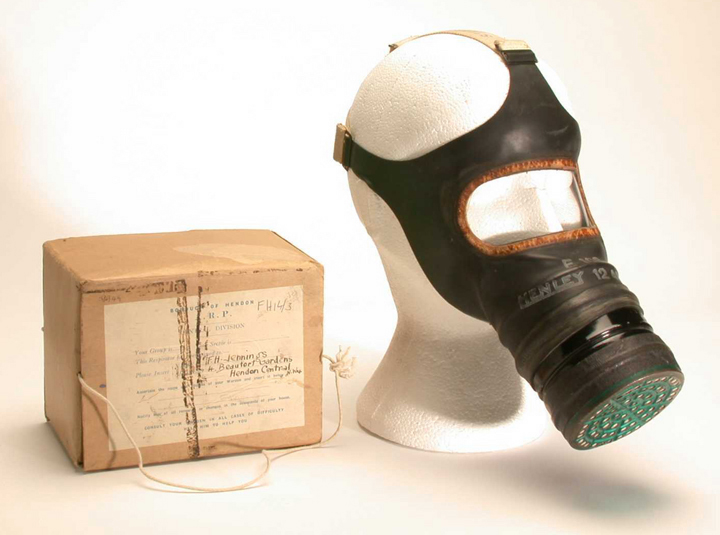
Gas Mask Length:26cm
Read More
In the build-up to World War II the British government feared that the Germans would attack Britain with poison gasA substance that causes death or injury when it is inhaled, absorbed or comes into contact with the skin.. During World War IThe First World War (1914-18) fought between the Allies (France, Russia, Britain, Italy, Australia, Canada and the USA) and the Central Powers (Germany, Austria-Hungary and Turkey). the Germans and Allies had used poison gas to attack each other in the trenches. Harmful gases can make the skin blister, cause blindness and breathing problems, and can even kill. The British government took precautions against poison gas attacks and by 1938 they had issued ‘civilian type respirators’ to every man, woman and child in the nation. There were versions for animals, too. Over 40 million gas masks were issued.
The Government waged a publicity campaign. People were told to keep their gas masks with them day and night. Posters about the dangers of gas attacks were everywhere by the outbreak of war. ‘HitlerHitler, Adolf – 1889-1945 – Germany's dictator 1934-45 will send no warning – so always carry your gas mask’, cautioned one poster. ‘It is your duty to yourself, your family and your country to be prepared. Don’t be caught without your gas mask when the wardensThe person responsible for ensuring that people took precautions against air raids e.g. checking that lights couldn't be seen, that people carried their gas masks. The wardens also took charge during air raids, ushering people into shelters, dealing with the aftermath of explosions and reporting attacks. sound their rattles. Don’t be a gas casualty.’ Short films and radio adverts also kept people informed. There were even events like ‘Gas Mask Week’ when talks on anti-gas measures were given in local town halls, and people could get their masks tested.
The Ministry of Home Security issued instructions on what to do in the event of a gas attack. When the ARPAir Raid Precautions – the precautions that the British government took in World War II to prepare and protect people from bomb attacks by the Germans. These included precautions against poison gas attacks. wardens sounded rattles to alert people to a gas attack, the directions were to ‘Hold your breath, put on your mask, cover your skin and take shelter in the nearest building.’ If you had inhaledInhale – to breathe in (air, smoke or vapour). some vapour gas you were advised to ‘keep your mask on even if you feel discomfort and seek help at a first aid post.’ The emergency services and the ARP were trained in dealing with gas attacks.
The gas mask attracted many nicknames, from ‘nosebag’ after the feedbags that horse wore round their noses, to ‘dickey-bird’. Many children called the gas mask a ‘Hitler.’ The gas mask was not popular and most people found it uncomfortable. It was tight fitting to prevent any fumes leaking into the mask. People sometimes felt claustrophobicClaustrophobia – the fear of being in a confined space. and the wearer’s breath tended to steam up the goggles after a few minutes. The sensation of clammy breathlessness and the smell of rubber disinfectant made people unwilling to practise wearing their masks. They also disliked carrying the masks everywhere. As the war progressed, it seemed less likely that there would be a gas attack and people tended to leave their cumbersome brown boxes and heavy gas masks at home. There was never a gas attack in Britain during World War II.
As asbestosA substance made of fibres, which was used in gas masks during World War II to filter out harmful gases. Asbestos is effective when it is new and stable but after a period of time it breaks down and it is possible to inhale the fibres. These can cause breathing problems and lead to asbestosis – a disease of the lungs. Old gas masks should never be worn due to the risk of inhaling asbestos. ages, it breaks down. We now know of the link between asbestos and lung disease. It is very important that all asbestos is professionally removed from old gas masks.
Gas Mask Length:26cm
Larger Image
Glossary
- ARP
- Air Raid Precautions – the precautions that the British government took in World War II to prepare and protect people from bomb attacks by the Germans. These included precautions against poison gas attacks.
- Asbestos
- A substance made of fibres, which was used in gas masks during World War II to filter out harmful gases. Asbestos is effective when it is new and stable but after a period of time it breaks down and it is possible to inhale the fibres. These can cause breathing problems and lead to asbestosis – a disease of the lungs. Old gas masks should never be worn due to the risk of inhaling asbestos.
- Claustrophobic
- Claustrophobia – the fear of being in a confined space.
- Filter
- To remove or separate particles from a liquid or gas using a filter substance.
- Hitler
- Hitler, Adolf – 1889-1945 – Germany’s dictator 1934-45
- Inhaled
- Inhale – to breathe in (air, smoke or vapour).
- Perforated
- Perforation – a hole or a series of holes.
- Poison gas
- A substance that causes death or injury when it is inhaled, absorbed or comes into contact with the skin.
- Wardens
- The person responsible for ensuring that people took precautions against air raids e.g. checking that lights couldn’t be seen, that people carried their gas masks. The wardens also took charge during air raids, ushering people into shelters, dealing with the aftermath of explosions and reporting attacks.
- World War I
- The First World War (1914-18) fought between the Allies (France, Russia, Britain, Italy, Australia, Canada and the USA) and the Central Powers (Germany, Austria-Hungary and Turkey).
- World War II
- The Second World War (1939-45) fought between the Allies (France, the Soviet Union, Britain, Australia, Canada and the USA) and the Axis (Germany, Italy and Japan).