
Beer Stein, Germany
Description
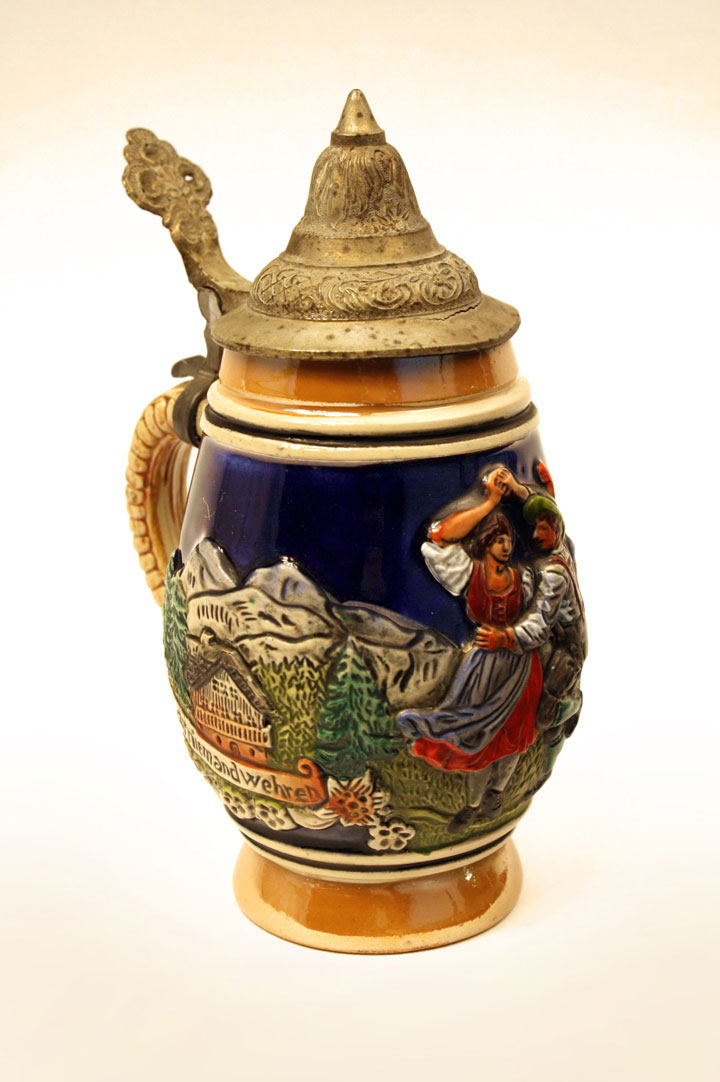
This stein has a dark blue background glaze and a metal hinged lid. It is decorated with a dancing couple framed against the Bavarian Alps and the slogan Ein trunk beim tanz in ehren den wird dir niemand wehren, which translates as ‘When dancing, a drink’s no harm, no one can bid you nay.’ The place shown in the name, Obing, is in Bavaria, south eastern Germany.
The beer stein is a traditional form of drinking vessel that originated in Germany during the 13th century. The word stein is a shortened form of Steinzeugkrug, which is German for stoneware jug or tankard. StonewareA hard opaque pottery, fired at a very high temperature. is tougher and harder than other forms of clay based material. The clay vitrifiesTo convert or be converted into glass. during firing and becomes very hard and non-porousAllows water, air, or other fluids to pass through it. once cool. Potters refer to this process as maturation.
The hinged lid, as seen in the stein above, came into use after the Black DeathOutbreak of bubonic plague that was pandemic throughout Europe and much of Asia in the 14th century. had killed millions of people across Europe. As well as the plague, invasions of flies in Europe caused further widespread disease. It became clear that standards of hygiene made a difference in the number of fatalities and so several German states passed sanitation laws to try to reduce the spread of disease. These laws required that food and drink containers be covered and also restricted the ingredients that could be used in beer making. Until then, any scraps such as rotting bread, cabbages, and eggs were thrown into the beer mulch but by insisting that only hops, cereals, yeast, and water be used, this stopped rotten food entering the beer making process. The knock-on effect of this was that the taste of German beer improved, and it became known as a superior alcoholic drink.
Larger Image
Glossary
- Black Death
- Outbreak of bubonic plague that was pandemic throughout Europe and much of Asia in the 14th century.
- Porous
Allows water, air, or other fluids to pass through it.
- Stoneware
- A hard opaque pottery, fired at a very high temperature.
- Vitrifies
To convert or be converted into glass.