
Bellows Camera, Victorian, Original
Description
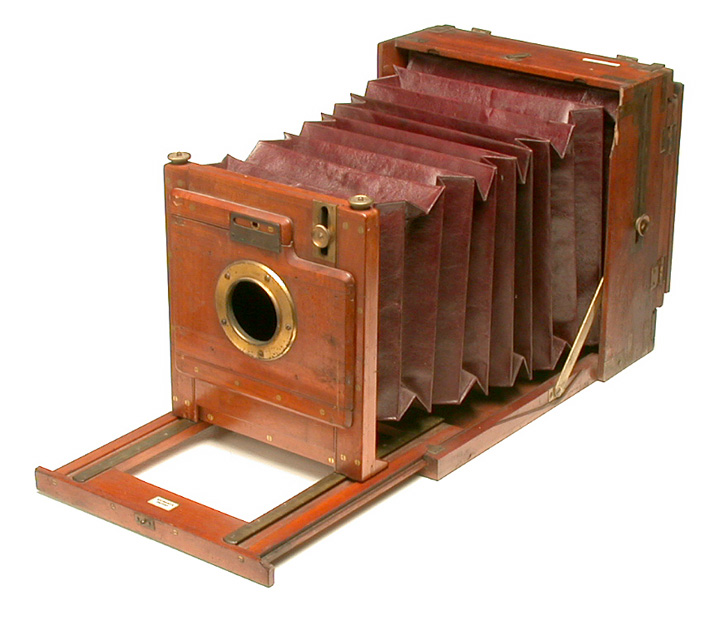
This camera dates from the 1850s. It is made of mahogany with brass
fittings, like most of the cameras of that time, and is very heavy.
Although it looks old fashioned to us, in fact it was a
technological breakthrough in its day. This camera had folded
leather bellows between the lens and film area. This made it
lighter than previous cameras, and it folded away into its own
carrying box. Some of camera’s parts, like the lens, are much the
same as in a modern camera. But the difference is that the parts
are much larger and are made of different materials.
With modern cameras small electronic and digital cameras we focus
the lens and take the picture at the press of a button. With the
bellows camera, all the parts had to be moved and adjusted by hand
and the film had to be specially prepared. This took time and
needed skill.
How it worked
The photographer opened up the camera and set it on the tripod.
Then he or she looked at the image formed on the focusing screen at
the back of the camera. By moving the lens forward and back, the
photographer composed and focused the picture. Then he or she
prepared the glass plate with chemicals and slipped it into the
back of the camera.
It took a while for the photo to appear on the glass plate. For
portraits, people had to stand or sit very still for up to half an
hour. From time to time, the photographer checked on how the photo
was developing. When the picture seemed ready, the photographer
removed the glass plate from the camera and fixed the image using
different chemicals.
This camera has several different names, which stand for the camera
parts or what it was used for – square bellows camera, folding
baseboard camera, flatbed camera, view camera and stand camera.
Length:38cm
Read More
Photographs were very popular in Victorian times. But cameras were
expensive and ordinary people couldn’t afford to buy them. Instead
they went to studios where professional photographers took photos
for a small fee. The bellows camera was the most common form of
camera found in the Victorian portrait studio.
Sometimes photographers took the camera with them on their travels.
Photographers went to villages or farms in the countryside and took
photos. In the 1861 census there were around 3000 professional
photographers in Britain, making their living by taking photos of
people.
Individual and family portraits were common, especially for wealthy
families. The photos were displayed in frames or in albums. It was
fashionable to set photos into pieces of jewellery – brooches,
pins, chokers, pendants and bracelets all featured small
photos.
Companies and organisations liked to have group photographs taken
too. Soon there were photos of workplaces and people working too.
Important events were photographed and featured in newspapers,
instead of artists’ drawings. Photos began to be used for
adverts.
As well as photos of people and events, photos of places of
interest were popular. Both professional photographers and wealthy
amateur photographers took photos on their travels. They took
photos of historical monuments like the Coliseum in Rome and new
buildings like the Eiffel Tower (1889). These photos were the only
way that ordinary people could see famous sites as only the rich
travelled abroad in Victorian times.
Photos became cheaper as cameras and film improved and they were
mass-produced in factories. The Kodak camera was introduced in 1888
and in 1900 the Browning came on the market. These cameras were
small and could be held in the hand. They were easy to use and less
expensive than previous cameras. Soon more and more people were
buying cameras and taking photos.
Although more modern cameras appeared in the late 19th century the
bellows camera was still used to take portraits and views of the
countryside. The bellows camera could take larger photos with a lot
of detail. And the photograph would give a number of prints from
the original.
Parts of the camera
The lens is the part of the camera that ‘sees’ the
picture. The lens focuses the picture onto the glass plate at the
back of the camera. The round lens was held by the brass ring at
the front of the camera. The original lens probably broke and now
there is just a hole in the box. The piece of wood that held the
lens was called the lens board
The plateholder at the back of the camera is a narrow box
with a removable cover. In the 1850s and 60s, photographers exposed
the pictures onto a glass plate at the back of the camera. The
glass plate was coated with light sensitive chemicals and
immediately put into the camera. When the picture was focused and
the plate had been exposed, it had to be taken out of the camera
quickly. Then the picture was developed using other chemicals, so
that it was fixed on the glass plate. The glass plate was like the
modern day negative and photos were printed from it.
The leather concertina part in the middle is the bellows.
This set of bellows is square. It connects the lens board to the
film area at the back of the camera. The bellows are flexible and
allowed the position of the lens to be changed to focus the
picture.
The baseboard or flatbed formed the base of the camera.
When it was opened it extended out and there were two grooves for
the lens board to move smoothly up and down. This let the
photographer focus on pictures at different distances. The
baseboard is hinged so that it closed up after use.
This camera was too large and bulky to hold. It sat on top of a
three-legged stand called a tripod. A black cloth or hood
was attached to the back of the camera and the photographer draped
it over his or her head and shoulders so that it was dark. No light
was let into the camera because it would spoil the photo.
The lens folded back into the box, the bellows squashed flat and
the hinged baseboard folded up to close. The wooden box protected
the glass lens and glass plate at the back from damage. This
carrying case made it easy to travel with the camera so the
photographer did not need to be based in a studio.
Length:38cm
Larger Image