
Clay Pipe, Tudor, Original
Description
Lighting up – Tudor style. Lighting dried tobacco leaves makes smoke that can be inhaled. Today, tobacco is smoked in cigarettes but in Tudor times clay pipes were used.
Pipes are designed to hold the smouldering tobacco and draw smoke into the mouth without burning the smoker. At one end of the clay pipe is a bowl. A stem goes from the bowl into the smoker’s mouth. The stem is hollow, so when the smoker sucks it, air is drawn down from the bowl.
A small wad of tobacco is placed in the bowl, and lit with a match or taper. The smoker sucks air down the stem, causing oxygen to pass through the tobacco, keeping it alight. The suction also draws smoke into the smoker’s mouth, to be inhaled, and exhaled as the smoker chooses.
Clay pipes were fragile, and as they frequently got very hot, they were often broken. Many pieces of clay pipe have been found around Tudor dwellings, especially inns and market places.
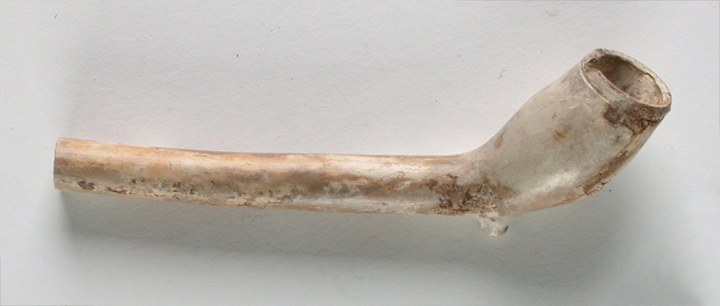
Length:11.5cm
Read More
Smoking was unknown in England until the reign of Elizabeth 1, when Sir Walter Raleigh returned from exploring the New World in 1565 with a cargo of tobacco. Smoking was soon popular with men, women and children. In 1560 Jean Nicot gave the plant its botanical name, Nicotiana, from which we get the word ‘nicotine’.
Tobacco was initially seen as a miracle cure, with health giving qualities. Catherine de Medici praised its curative power. It was soon realised that it was also an addictive substance. Tobacco smoking was already widespread in America and the West Indies, and by the end of the 16th century this was also the case in Europe.
The use of tobacco created the need for something to smoke in, and pipes were developed. Craftsmen began to make pipes from a variety of materials, including clay. Many beautiful and varied designs were created by pipe makers, reflecting both their skills, and the time and place when they were made.
Clay pipes were made from mature clay, which was first beaten with an iron bar to remove all air. If air remained in the clay the pipes would break when they were being fired in the kiln. A prepared portion of clay was called a pillThe term for a portion of clay ready to make pipes.. From the pill a pipe maker took a nipThe portion of clay needed to create one pipe., precisely enough clay with which to create a pipe. The nip was made into a rollA long length of clay with a round lump at the end., a snake like length of clay with a round lump, or head at the end. The rolls were stacked in a pile called a bunchA pile of rolls ready for wiring.. Each roll was then wiredWiring – the process of creating an air passage in a pipe the process of creating an air passage in a pipe. by pushing a piercing rod up towards the head, creating an air passage for the smoker to draw hot tobacco smoke into his or her mouth. The wired roll was then placed in a pipe mould. Inside the mould the clay would take on the required shape of the pipe. The pipe mould was lightly greased to ease the pipe’s removal from the mould after its shape had been created. After the pipe was removed from the mould, it was air-dried, trimmed and burnished using special tools. Finally the pipes were stacked in saggersA collection of pipes ready for firing., and fired in a kiln. After firing and inspection, the pipes were packed in wood shavings for transport, to prevent breakage.
Tobacco was first sold by apothecaries. By 1600, as demand increased, specialist tobacco shops opened and tobacco was also sold in inns, grocers, chandlersChandler – originally, a maker or seller of candles, from the French chandelier. The English Tallow Chandlers were incorporated in 1462. and drapersDealers in cloth and linen. shops.
Length:11.5cm
Larger Image
Glossary
- Bunch
- A pile of rolls ready for wiring.
- Chandlers
- Chandler – originally, a maker or seller of candles, from the French chandelier. The English Tallow Chandlers were incorporated in 1462.
- Drapers
- Dealers in cloth and linen.
- Nip
- The portion of clay needed to create one pipe.
- Pill
- The term for a portion of clay ready to make pipes.
- Roll
- A long length of clay with a round lump at the end.
- Saggers
- A collection of pipes ready for firing.
- Wired
- Wiring – the process of creating an air passage in a pipe the process of creating an air passage in a pipe.