
Cyclist, Reused Materials, Zimbabwe
Description
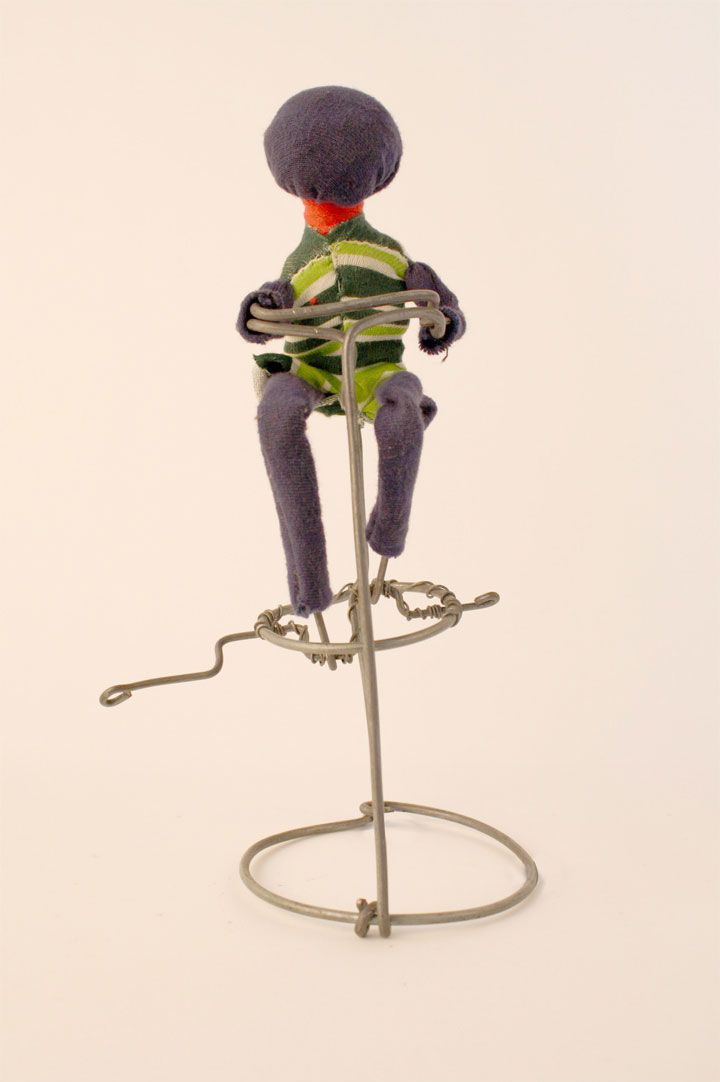
This is a fascinating little piece of art made from reused wire
and fabric. We know instantly that it is a cyclist but there is no
bicycle. So how does it work? How does the maker achieve this
trick?
It is a representational piece. Our eyes see the position of the
hands on what are obviously the handlebars and make an instant
deduction. We then have to unpick what we see and notice what is
actually there and what is indicated by the design and the action.
We can follow the legs to the pedals, and then we notice that there
are no actual pedals and no actual feet. Finally we notice that
there are no wheels, no bicycle frame.
Turning the handle on the side shows the pedaling motion of the
cyclist, both forwards and backwards, but the rest is in the
mind.
Height:21cm
Larger Image
Moving Object
This is a fascinating little piece of art made from reused wire
and fabric. We know instantly that it is a cyclist but there is no
bicycle. So how does it work? How does the maker achieve this
trick?
It is a representational piece. Our eyes see the position of the
hands on what are obviously the handlebars and make an instant
deduction. We then have to unpick what we see and notice what is
actually there and what is indicated by the design and the action.
We can follow the legs to the pedals, and then we notice that there
are no actual pedals and no actual feet. Finally we notice that
there are no wheels, no bicycle frame.
Turning the handle on the side shows the pedaling motion of the
cyclist, both forwards and backwards, but the rest is in the
mind.