
Gas Light, Edwardian, Original
Description
The incandescent gas lamp was invented in 1885, and it was popular
until the 1920s when most places had electric lighting. This lamp
may have illuminated a room, a shop, an office or a public place
like a station waiting room. When lit, it gave a brilliant white
‘incandescent’ light. This light was brighter than any gaslight
seen before. Ordinary gas lamps in the 19th century gave out a weak
yellow light.
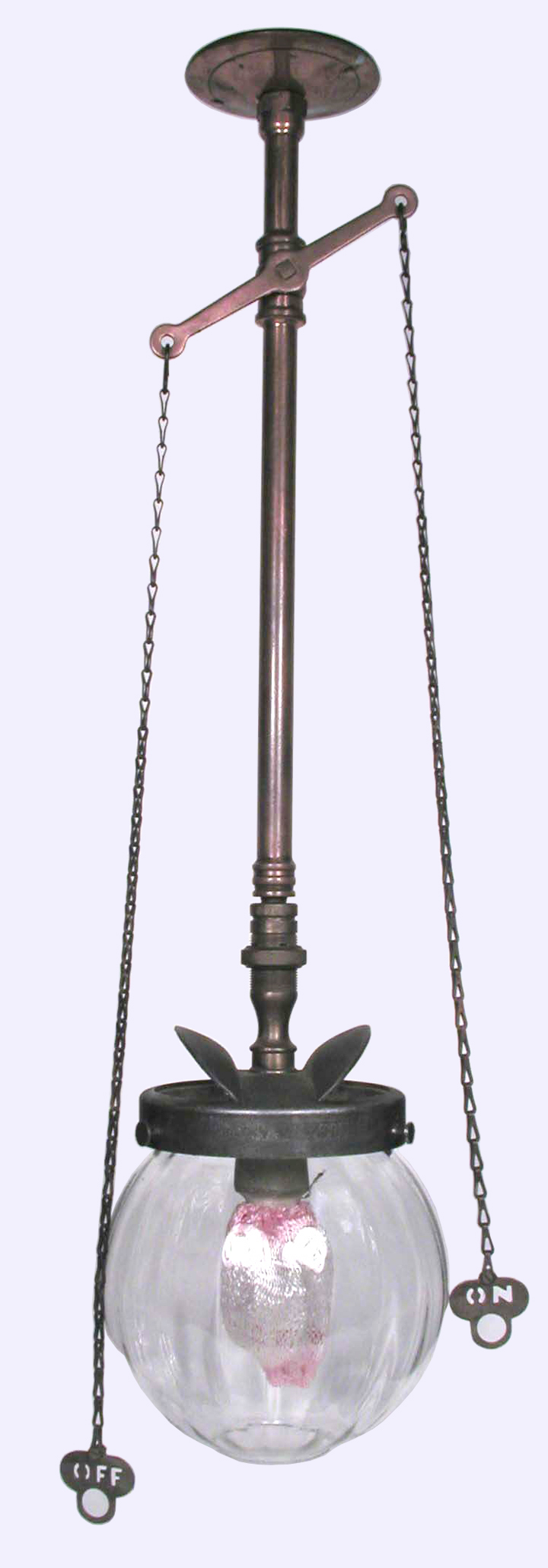
This light is made of:
round plate with small holes for screws to attach it to the
ceiling. It was often hidden in plaster decorations on the ceiling,
with ventilation holes.
Rod. A brass and copper rod hung down from the
ceiling. The gas came from the mains supply and travelled down
through the rod to the mantle.
Lever cock. A bar is attached near the top of the
rod. It was a mechanism for turning the gas supply on and off.
Two chains made of metal links and hang from
either side of the lever.
Tablets. Each chain has a brass tab on the bottom.
One has ‘ON’ stamped out of the metal above the ring pull and the
other has ‘OFF.’
Mantle. A roll of cloth was attached to the gas
burner and impregnated with chemical salts so that the mantle gave
off a brilliant white light when it burned. Mantles had to be
replaced frequently. (This is not the original mantle.)
Globe. The round lampshade made of clear
glass.
Globe gallery. The metal frame at the bottom of
the rod that holds the glass shade in place.
To turn on the lamp the person pulled the ‘ON’ tab and chain. This
pulled the lever down on the right and opened the gas supply to the
lamp. Then the person put a taper or candle to the mantle and held
it there for several seconds. The cotton or silk burned away and
the chemical salts glowed brightly. Then the mantle was lit and
gave out a strong light. To turn it off the person pulled the ‘OFF’
tab. This moved the lever down on the left, closing the gas supply,
and turning the light off.
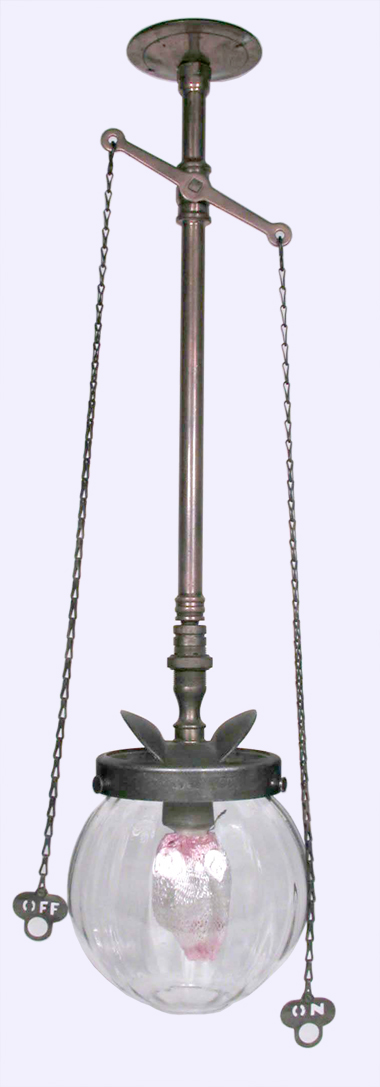
Alternative view
Height:50cm Glass Diameter:12cm
Read More
At the start of the Victorian period candles and oil lamps lit most
houses. By the end of the period, gas lighting was common in homes
in cities and towns, and electricity was being introduced in many.
Early gas lamps gave out a weak light and lots of heat.
The gas travelled through a pipe and the end was lit, giving a
flame like a candle. Even when a glass chimney was put over the
flame to make it stronger and brighter, it still only gave off a
light equal to around 8 candles.
The gas mantle was a way of producing more light. Carl Aur von
Wesbach invented it in 1885. The mantle gave a bigger area for the
light to burn. The mantle was made of silk or cotton cloth and
impregnated with non-flammable chemicals. When lit, the cotton
burned away to leave the chemical filaments glowing white hot or
‘incandescent.’
The incandescent light was harsh, white and extremely bright.
(Rather like modern day fluorescent strip-lights.) The Victorians
had been used to the gentle glow of candlelight, oil lamps and
simple gas lamps and some complained that the incandescent light
hurt their eyes and lit up an area too clearly. But incandescent
lamps became popular and over 300,000 were sold by 1895.
There were three sizes of mantles. These gave different amounts of
light. Full size gave about 90 candlepower and was probably used in
street lighting. Medium gave 60 candlepower and was probably used
in shop lighting. Bijou, meaning small, gave 30 candlepower and was
used in homes.
There were different kinds of pendant lights. There was the simple
pipe that hung from the ceiling with one burner, or it would have a
crossbar at the bottom holding two burners. A light with three or
more arms was called a gasolier or chandelier.
In pendant gas lights, the fashion was for a single rod with fancy
brass decorations, like two swan necks at the bottom of the pole.
Fancy brass ornaments were sold separately and could be attached
easily to any plain pendant to make it more ornate. Bowls or silk
frills could be hung from the lights too.
Gas lampshades were often made of frosted or coloured glass. They
sometimes had cut glass decorations or etched patterns. The fashion
for ornate designs changed at the end of the 19th century. Glass
shades began to be made in plainer designs, like the one
pictured.
The design of the gas burner changed little over the years. From
around 1900 until 1914, the burners were made of brass or copper.
In the 1920s and 1930s these gave way to simpler designs in
aluminium and magnesia. The cloth mantles had a short life span and
were replaced regularly when they burnt out.
Incandescent gas mantles were used wherever bright light was needed
– for shop and street lighting, and in offices and workplaces. The
burners had one mantle or a cluster of mantles because they gave
out more light. After 1885, London’s street lamps were fitted with
incandescent mantles.
Incandescent lights were mainly used from 1885 to the 1920s. More
and more homes were lit by electricity at the beginning of the 20th
century. After World War I electric lighting became the main
lighting in homes. People had stopped using incandescent lamps by
the 1930s. Incandescent mantles can still be seen in camping lamps
today.
Height:50cm Glass Diameter:12cm
Larger Image