
Home Guard Booklet, World War II, Original
Description
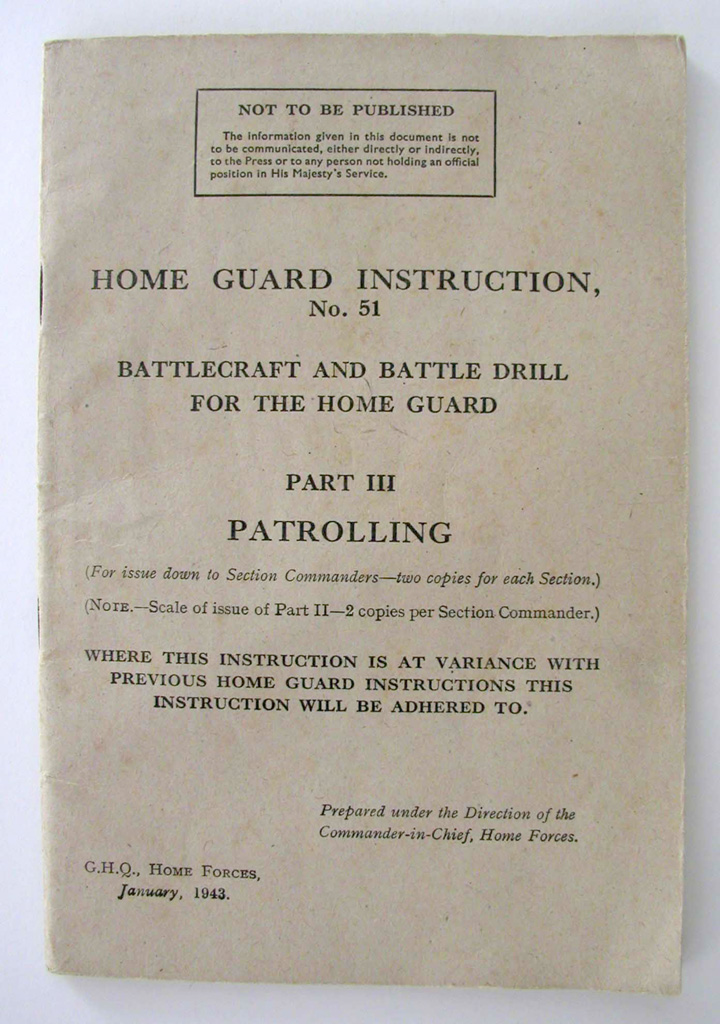
This booklet, BattlecraftA word used in WWII, meaning skill in military tactics and fighting. and Battle DrillTo instruct or be instructed in military procedures or movements. for
the Home Guard, was published in 1943. The British government
feared a German invasion during World War II, and so set up the
Local Defence VolunteersThe original name for the Home Guard before it was changed by Winston Churchill./Home Guard (HG) in 1940. The HG was
made up of volunteer units of men in towns and cities across
Britain, and was sometimes known as ‘Dad’s ArmyThe name given to the Home Guard because so many of the volunteers were relatively old, compared to the regular army. It is also the name of a comedy series from the 1970s, based on the Home Guard.‘. Their job
was to observe and report any signs of enemy presence, and to
defend their local area against enemy invasionThe act of entering a country with armed forces, when not welcome.. The
volunteers trained every week and practised manoeuvres that would
prepare them to fight off an attack.
Each unit had to patrolThe action of going round an area or building at regular intervals for the purpose of security or observation. their local area regularly, and this
booklet, which was issued to sectionA subdivision of the Home Guard. commandersSection commander – the officer in charge of a section in the Home Guard, equivalent to a sergeant in the army., has
instructions and diagrams on patrolling. The instructions include –
how to patrol in particular areas, such as woodland and streets;
how to scale walls and search houses, and how to use
grenadesSmall bombs filled with explosive or gas, thrown by hand or fired from a rifle.. There are five chapters: Dealing with the General
Characteristics of a Patrol; Scouts; Methods of Carrying Out
Patrols; Fighting Patrol Against Airborne Troops, and Patrolling in
Built-up Areas.
Weapons and uniforms were prioritised for the regular army so the
Home Guard often had to improvise. The booklet shows how to make a
homemade periscopeAn instrument used to see objects on a higher level, like that used in a submarine. (to look over bushes and walls while on
patrol) and hessianA coarse fabric similar to sack material. covers for boots, to quieten footsteps
so that one could move around without detection.
Length:18cm
Read More
The Home Guard was made up of over a million men, aged from 17 to
65, who volunteered at their local police stations. They were
usually men who were not eligible for the regular army – older
recruits, men who did not pass the medical test for the regular
army, and those in reserved occupations. Although many of the older
recruits were World War 1 veteransSoldiers who have seen a lot of active service, fighting in war. with military experience,
most of the volunteers were untrained.
Platoons of PrivatesPrivate – the name for a volunteer in the Home Guard. usually trained once a week. They
learnt how to keep watch and report on the situation in their town,
village or city, and how to fight. Training covered patrolling,
weapons’ handling, unarmed combat and basic sabotageThe deliberate destruction or damage of equipment.. The
Home Guard had to be prepared to attack the enemy, with or without
weapons, and destroy German weapons and equipment should they
attempt to invade from the air, sea or land.
The Home Guard sections were issued with a series of
instruction booklets dealing with areas of ‘battlecraft’ as diverse
as signalling and map reading to using anti-tank gunsGuns that can destroy enemy tanks.. There
were units like the Upper Thames Patrol that patrolled the river,
and factory units formed of workers to protect the premises in an
emergency. Although they had different places to guard, the
Privates were still trained in the same way.
The Privates were expected to have an excellent knowledge of their
local area, so that they would be aware of places that enemy
soldiers could hide. They practised patrolling the area and to find
vantageVantage point – a position that gives an overall view of a scene or situation. points and hiding places in bunkers, caves and
buildings. This helped them to work out where the enemy could hide,
and where they could take cover themselves in order to mount
counter-attacks. The Home Guard took down road signs and local
clues to confuse the Germans, so that if they invaded they would
quickly become lost.
Home Guard Patrols had to be skilled in moving quickly and
stealthily as a team. The instructions booklet Battlecraft and
Battle Drill for the Home Guard emphasises the need to stay
out of sight and close to the ground, to move in formation, and to
keep continuous all-round observation. A handy list of hints on
page 40 of summarises what not to do. ‘Don’t
loiter below windows…Don’t search obvious places. The enemy isn’t
a fool,’ and, ‘Don’t throw your weapons about. They must shoot
straight when you meet the enemy.’
As well as knowing their area, the Privates were expected to be
familiar with the local population. They had to keep their eyes
open for enemy spies and saboteursPeople who commit sabotage.. They acted as sentries,
checking identity cards and following up reports of strangers.
The Home Guard was known as ‘Dad’s Army’ because of the number of
older volunteers. The Germans never invaded and the Home Guard did
not get the opportunity to prove their abilities and skill in
action. Whilst they were generally seen as amateurs, specialist
units like the coast defence, anti-aircraft, motor transport and
bomb disposal units played an active part in air raids. And 137
members of the Home Guard were awarded medals and commendations for
valour and risking their lives to save others during the war.
Length:18cm
Larger Image
Glossary
- Anti-tank guns
- Guns that can destroy enemy tanks.
- Battlecraft
- A word used in WWII, meaning skill in military tactics and fighting.
- Commanders
- Section commander – the officer in charge of a section in the Home Guard, equivalent to a sergeant in the army.
- Dad's Army
- The name given to the Home Guard because so many of the volunteers were relatively old, compared to the regular army. It is also the name of a comedy series from the 1970s, based on the Home Guard.
- Drill
- To instruct or be instructed in military procedures or movements.
- Grenades
- Small bombs filled with explosive or gas, thrown by hand or fired from a rifle.
- Hessian
- A coarse fabric similar to sack material.
- Invasion
- The act of entering a country with armed forces, when not welcome.
- Local Defence Volunteers
- The original name for the Home Guard before it was changed by Winston Churchill.
- Patrol
- The action of going round an area or building at regular intervals for the purpose of security or observation.
- Periscope
- An instrument used to see objects on a higher level, like that used in a submarine.
- Privates
- Private – the name for a volunteer in the Home Guard.
- Sabotage
- The deliberate destruction or damage of equipment.
- Saboteurs
- People who commit sabotage.
- Section
- A subdivision of the Home Guard.
- Vantage
- Vantage point – a position that gives an overall view of a scene or situation.
- Veterans
- Soldiers who have seen a lot of active service, fighting in war.