
Makishi Mask, Zambia
Description
CikunzaAn ancestral spirit who appears at ceremonies as a masked character. ‘The Father of Masks’ ‘The Father of Initiation’
Throughout the continent of Africa masks are used in ceremonies. Traditional masks symbolize spirits and people believe that the power of the spirit is present in the mask. This mask is from the ChokweA nation of African people who live in parts of Angola, the Democratic Republic of Congo and Zambia. people who live in Angola, the Democratic Republic of Congo and Zambia, and represents an ancestral spiritThe spirit of someone who is long dead. called Cikunza. This spirit has a major role in festivals and initiation ceremonies.
The mask is cone-shaped because this is the shape of an antelopeA hoofed, wild, mammal found in Africa and Asia. Antelopes are typically fast-running and graceful, grazing or browsing in large herds on open grasslands. All male antelopes, and some females, have horns.‘s horn and Cikunza is associated with hunting. It fits over an adult’s head. It is made from woven plastic, painted black and decorated with red and white stripes. At the base is a fringe of fibres that hide the wearer’s neck. The tassel at the top of the mask swirls around when the Cikunza dances. The mouth is open in a threatening manner.
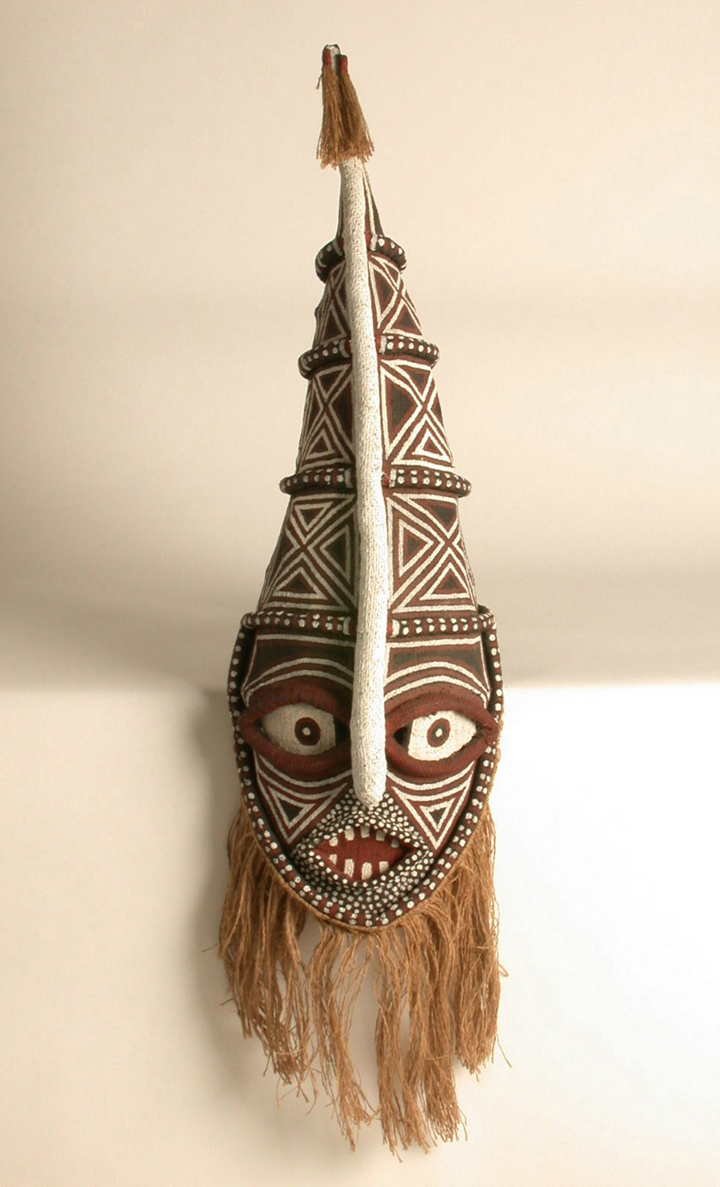
Length:126cm
Read More
CikunzaAn ancestral spirit who appears at ceremonies as a masked character. ‘The Father of Masks’ ‘The Father of Initiation’
Masks are worn by dancers during celebrations and important ceremonies such as initiations, weddings and funerals. They are also used in law-making by chiefs and rulers. There are many different spirits in African culture and each spirit has a different mask. This mask is particular to the ChokweA nation of African people who live in parts of Angola, the Democratic Republic of Congo and Zambia. people and it represents an ancestral spiritThe spirit of someone who is long dead. called Cikunza. Cikunza is the spirit associated with hunting and the mask’s shape is like an antelopeA hoofed, wild, mammal found in Africa and Asia. Antelopes are typically fast-running and graceful, grazing or browsing in large herds on open grasslands. All male antelopes, and some females, have horns.‘s horn. Cikunza is also associated with fertility and shares its name with an African grasshopper that breeds quickly.
Cikunza is a key character in mukanda, the initiation ceremonies for boys. In the Chokwe culture, when boys reach pubertyThe stage in a person's life, during the teenage years, when the body goes through certain changes. Girls become women, boys become men, and they are able to have children. (around 13-16 years), they undergo rituals and ceremonies to prepare them for the change to adulthood. The Cikunza mask is usually worn by an older man with experience of the world, since he is responsible for teaching the boys the skills and knowledge they need for adult life, including hunting and issues around sex. The man takes care to disguise his appearance, so the mask is designed to covers his face while the fringe hides his neck. His body is painted and he wears a fringed skirt around his waist. When he / Cikunza dances he places his feet firmly apart on the ground and twirls his hips to create a fanning motion with the skirt. Cikunza sometimes carries a sword (mukwaleA double edged sword. It is sometimes carried by the Cikunza character as a symbol of authority or weapon of execution.) in his right hand and a spreading branch (citeteA tree branch. The Cikunza holds it to ward off intruders from the initiation camp.) in his left. He uses these in the mukanda to scare off intruders to the camp because what the boys learn must remain secret.
The Cikunza character signals the beginning of the mukanda and collects the boys from their homes, leading them to a secret camp in the forest. This camp is called ‘the place of dying’ because it is believed that the boys ‘die’ and are reborn as men. There, the boys are circumcisedThe removal of all or part of the foreskin. In many cultures circumcision forms part of a ceremony initiating boys into adult life.. The main secret they learn is that the spirits are actually men wearing masks. In a solemn ceremony, they remove masks from the figures to reveal relatives, neighbours and other men from the village. The boys then swear an oath that they will never disclose this information to anyone who has not been initiated.
Length:126cm
Larger Image
Glossary
- Ancestral spirit
- The spirit of someone who is long dead.
- Antelope
- A hoofed, wild, mammal found in Africa and Asia. Antelopes are typically fast-running and graceful, grazing or browsing in large herds on open grasslands. All male antelopes, and some females, have horns.
- Chokwe
- A nation of African people who live in parts of Angola, the Democratic Republic of Congo and Zambia.
- Cikunza
- An ancestral spirit who appears at ceremonies as a masked character.
- Circumcised
- The removal of all or part of the foreskin. In many cultures circumcision forms part of a ceremony initiating boys into adult life.
- Citete
- A tree branch. The Cikunza holds it to ward off intruders from the initiation camp.
- Mukwale
- A double edged sword. It is sometimes carried by the Cikunza character as a symbol of authority or weapon of execution.
- Puberty
- The stage in a person’s life, during the teenage years, when the body goes through certain changes. Girls become women, boys become men, and they are able to have children.