
Man’s Hat, Bolivia
Description
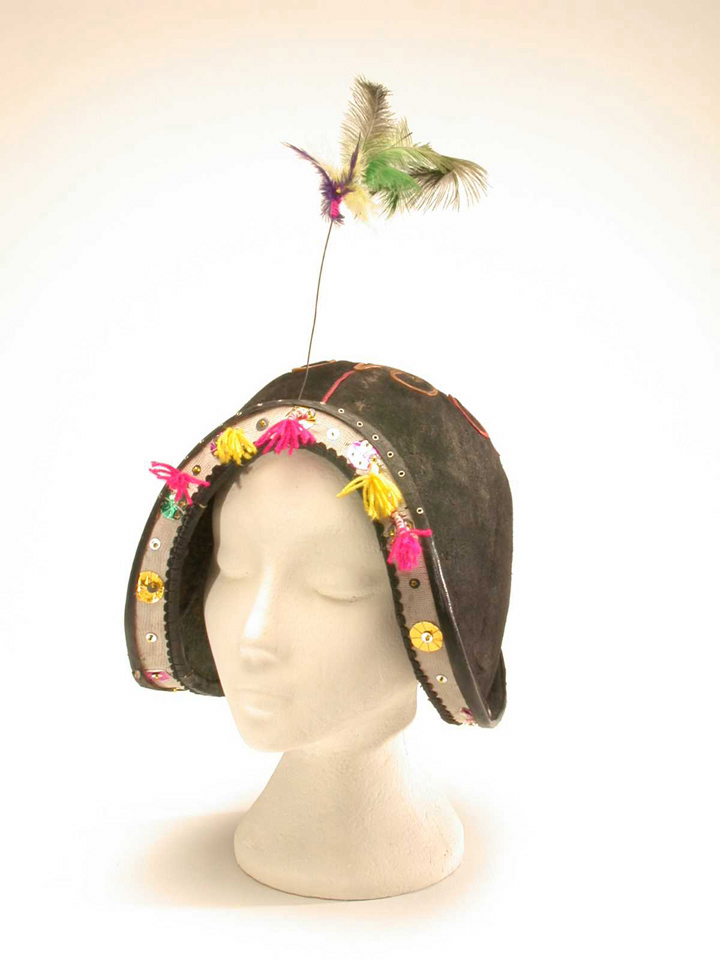
This hard hat from Bolivia, central South America, looks appealing but smells appalling. This is because the hat is made from cow dung, straw and paper. These materials were mixed together and moulded into the helmet shape then left to dry, much like papier-mâchéA hard substance made of layers of paper mixed with water, and moulded whilst wet..
The hat is covered with black felt, and strips of pink and brown leather are sewn in a pattern on the crownThe highest or central curved part of the head or hat.. Sequins, shiny paper circles and small bunches of pink and yellow wool are sewn onto the white nylon material at the brimThe projecting edge of a hat.. The final adornment is a plume of green, yellow and purple feathers flying out from a wire above the hat.
This hat comes from the AltiplanoThe area of 'high plains' in the west of Bolivia, where the land is mainly flat and the climate is cold. (high plains) region in the west of the Bolivia. This is where one of the two Indian groups in Bolivia, the AymaraOne of the two Indian peoples from Bolivia. The majority of the Aymara live in Carabuco, an area in the west of the country and north of the capital La Paz. Indians, live. Aymara men wear hats daily, but for ordinary wear hats would not have feathers. With this hat, feathers may have been added for a special occasion. The low drop in the brim could be to shelter the head from the biting cold weather of the Andes or the design could be to protect the neck from evil spiritsGhosts: the non-physical part of people, believed to live on after death.. According to Aymara legend, spirits can cut open the neck of a person and steal the soul, after which the person sickens, and dies. So the hat is protection from both natural and supernatural elements.
Read More
Bolivia is in central South America and is landlocked by Peru, Chile, Paraguay, Brazil and Argentina. The AymaraOne of the two Indian peoples from Bolivia. The majority of the Aymara live in Carabuco, an area in the west of the country and north of the capital La Paz. Indians were brought under Spanish rule in the 16th century but their remote highlands home meant that they retained much of their traditional way of life, values and beliefs. The majority of Indians are miners, factory workers or farmers, growing coca, coffee, corn, cotton, and rice and tending to cattle. Traditional crafts such as weaving textiles, and making gold and silver ornaments and ceramicsTiles, plates and homeware items made from clay, earthernware, stoneware or porcelain. are still thriving. Their everyday clothes tend to be traditional in style and suited to life in the highlands, which is often cold.
As well as this helmet-shaped hat, the Aymara have other styles of hats. These include close-fitting woolly hats with earflaps, and tall felt hats. Today many men wear modern hats such as baseball caps. Men’s dress in the highlands consists of a warm poncho over a homespun shirt and loose trousers. These are often made from sheep and llama wool.
Indian women commonly wear bowlerBowler hat – a stiff felt hat with a rounded crown and a narrow brim. It is usually associated with businessmen in the first part of the 20th century. hats or tall felt hats in Bolivia. These hats are said to be based on those worn by early British railwaymen. One story claims that the hats were originally dumped on the Bolivian market in the mid-19th century, by a Manchester hatter who had over-produced. The shape and style of the hats varies according to the different regions. The Aymara in the high plains region wear smallish bowler hats on top of a headscarf. Again, the headscarf protects the nape of the neck from the spiritsGhosts: the non-physical part of people, believed to live on after death. and vampires of local superstition, as well as from the severe cold.
In their daily dress, highland Indian women wear several brightly coloured petticoats, making their full skirts stick out. Shawls are wrapped around their shoulders and the women often use them to carry their goods to market for sale. The shawlA piece of cloth worn over the head or shoulders of a woman, or wrapped around a baby. can also bundle up their purchases, extra clothing and even support babies, leaving the women’s hands free. Boots are sturdy for walking on rough ground and to keep feet warm.
Larger Image
Glossary
- Altiplano
- The area of ‘high plains’ in the west of Bolivia, where the land is mainly flat and the climate is cold.
- Aymara
- One of the two Indian peoples from Bolivia. The majority of the Aymara live in Carabuco, an area in the west of the country and north of the capital La Paz.
- Bowler
- Bowler hat – a stiff felt hat with a rounded crown and a narrow brim. It is usually associated with businessmen in the first part of the 20th century.
- Brim
- The projecting edge of a hat.
- Ceramics
- Tiles, plates and homeware items made from clay, earthernware, stoneware or porcelain.
- Crown
- The highest or central curved part of the head or hat.
- Papier-mâché
- A hard substance made of layers of paper mixed with water, and moulded whilst wet.
- Shawl
- A piece of cloth worn over the head or shoulders of a woman, or wrapped around a baby.
- Spirits
- Ghosts: the non-physical part of people, believed to live on after death.