
String Puppet, Burma (Myanmar)
Description
Does this dragon string puppet look ferocious? Think of some
stories that you know about dragons – are they ferocious or kind?
Clever or silly? Dragons feature in myths and stories around the
world and they have different qualities in each tradition. In China
and Southeast Asia it is believed that they bring good luck and
prosperity and they are rarely depicted as malevolent.
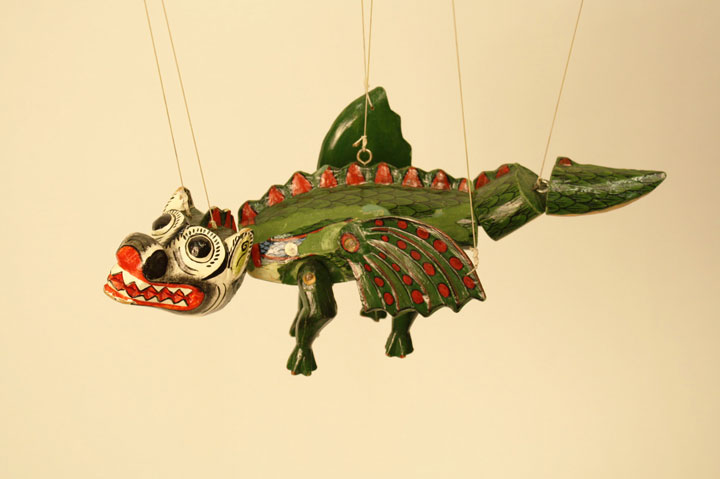
This dragon is from Burma (Myanmar) where there is a long
tradition of puppet shows using string puppets. It is painted
mainly in green with red and black decorations. You can see that
very sharp white teeth in a red mouth have been painted, too. It
has wings and a jointed tale in two parts. Its feet have five
claws.
There are many different traditions about the number of claws on
a dragon – some have three, some four and some five. One story from
China is that a dragon has fewer claws the further it has
travelled, which compares with Japan where the story is that a
dragon has more claws the further it travels. Another is that
five clawed dragons are connected with the Imperial court in China.
Interestingly, the traditional Asian dragon or Naga is usually a
serpent, and it is only the European dragon that has wings. So we
are not quite sure of the story behind this one – or maybe it was
made for the tourist market.
This dragon is a simple string puppet. String puppets work by
having a body made of movable parts that can be manipulated by
pulling on the strings attached to each section. This one has
strings connected to its tail, the tips of each wing, two on its
head and one on the centre of its back. These are tied to one
cross-shaped piece of wood called a control that is used to
manipulate each part.
Length:39cm
Larger Image