
Plucked Drum, India
Description
(Known as Khamak / khomok / ananda lahari / gubgubi / bogla.)
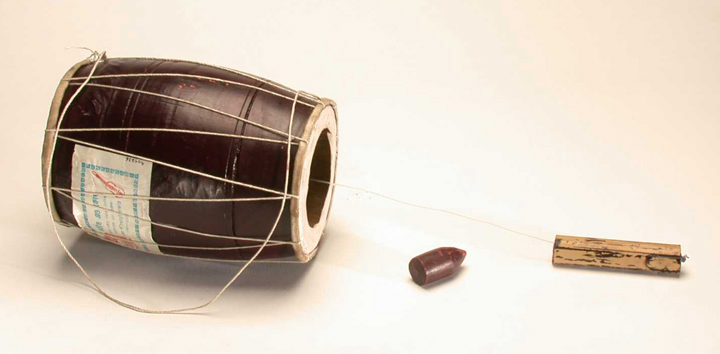
This is a khamak or a lahari (meaning ‘Joyful wave’). The khamak is played in many parts of the Indian sub-continent. It is best known as the instrument played in Bengali folk music by BaulBauls – a religious group who sing and play musical instruments, including the khamak. Baul music is the most popular kind of Bengali folk music. singers, along with other percussion instruments such as tablaA pair of small drums played with the hands. This instrument originally comes from India. and mandeeraHand cymbals..
It is a single stringed musical instrument that looks like a drum with a wooden body and a head made of skin. The head is pierced with a nylon cord which is attached to a button to stop it passing all the way through the skin. The other end of the cord goes through the instrument to come out the bottom opening and is attached to a small wooden handle. The bottom opening is made of skin that has been cut away in a circle, leaving a border.
How it is played
The musician places the drum body under his / her left arm. The string is pulled tight, placing tension on the drum. The player holds the picA thin flat piece of plastic etc. for plucking the strings of a musical instrument, also known as a plectrum. in the right hand and plucks the cord to make a vocal-like sound. Players can vary their grip on the handle to change the tension of the cord and make different sounds, as well as keeping the rhythm.
Drum Length:22.5cm
Read More
Sound & workings
One of the instrument’s names is ananda lahariThe literary name for the khamak. This word means 'waves of joy' in Bengali. meaning ‘waves of joy.’ This is a literary name and in the countryside it is better known as gubgubi or khamak – khamak from the sound that the instrument makes when it is played. Although it looks like a drum, the main sound is produced by plucking the string, so it is classed as a stringed instrument – a variable tension chordophoneA term used to classify an instrument where a vibrating string makes a musical sound e.g. khamak, harp, violin etc. 'chord' refers to a string.. It is a unique Indian type of instrument known as a ‘plucked drum’ and is part of a family that includes the ektara and dotara (one-stringed and four-stringed plucked drums.)
How it is made
The khamak tends to be made by the musicians themselves using natural materials found locally. Different varieties of khamak are made using wood, metal, gourd or clay resonatorThe part of a musical instrument which gives volume and quality to a sound (not the originator of the sound).s. The varying drum materials give quite different sounds. Traditionally the string is made with a length of animal gut. BaulBauls – a religious group who sing and play musical instruments, including the khamak. Baul music is the most popular kind of Bengali folk music. instruments are of a simple design.
The Baul
The Bauls have lived in West BengalA region in the north-east of the Indian subcontinent. Bengal, along with the rest of India, was colonised by the British in the 19th century. In 1947 India won its war of independence from the British. The province of Bengal was divided into West Bengal, which has remained a state of India, and East Bengal, now Bangladesh., in the extreme northeast of India for hundreds of years, perhaps a thousand. Traditionally, they were a religious sect who wandered the countryside, singing their religious songs. Baul beliefs are a mixture of many influences and traditions, such as Hinduism, Sufism and Yoga. The songs are often sensuous and erotic; they speak of devotion to God, but can easily be understood as declarations of human love or love for humanity.
Baul music is unlike other traditional Indian classical music. All of the instruments played are ancient in origin. The songs are simple, and sung with intense emotion. The music is approachable – unlike many forms of Indian classical music, no special knowledge or study is needed to fully appreciate Baul music. Baul musicians wear dhotis, a saffron turban and robes and beads made of basil stems, and they sing and dance to the music that they play.
Contemporary relevance
Today, Baul music is played throughout the Indian sub-continent in concerts and at special events. This music has gained a wider audience through performance at international ‘world music’ festivals and is currently undergoing a revival. New musicians are using the traditional instruments such as the khamak, and fusing the songs with modern beats and sounds to give it a popular and contemporary sound. Its appeal has widened to take in the younger generations.
Drum Length:22.5cm
Larger Image
Glossary
- Ananda lahari
- The literary name for the khamak. This word means ‘waves of joy’ in Bengali.
- Baul
- Bauls – a religious group who sing and play musical instruments, including the khamak. Baul music is the most popular kind of Bengali folk music.
- Bengal
- A region in the north-east of the Indian subcontinent. Bengal, along with the rest of India, was colonised by the British in the 19th century. In 1947 India won its war of independence from the British. The province of Bengal was divided into West Bengal, which has remained a state of India, and East Bengal, now Bangladesh.
- Chordophone
- A term used to classify an instrument where a vibrating string makes a musical sound e.g. khamak, harp, violin etc. ‘chord’ refers to a string.
- Mandeera
- Hand cymbals.
- Pic
- A thin flat piece of plastic etc. for plucking the strings of a musical instrument, also known as a plectrum.
- Resonator
- The part of a musical instrument which gives volume and quality to a sound (not the originator of the sound).
- Tabla
- A pair of small drums played with the hands. This instrument originally comes from India.