
Spur, World War I, Original
Description
This curious object is a spur and is attached by the leather
strap to the heel of a riding boot. It consists of a metal U shaped
yoke with a protruding wheel of spikes that rotates. This is called
a rowel. Spurs are worn in pairs – one for each foot – and
are used by equestrians to help control and direct a
horse.
Spurs have been used for centuries, particularly in the
military; spurs made from iron or bronze were worn by the ancient
Celts, Romans and Greeks. The word comes from an old
Anglo-Saxon spura. Medieval knights wore silver coated
spurs and the phrase “to win his spurs” meant to gain his
knighthood. You might also have noticed cowboys wearing spurs in
films. Spurs are worn with the leather strap over the front of the
ankle and the metal U cupping the back of the heel. The rowel
sticks out behind the heel so that the rider can use it to touch
the ribs of the horse. When used carefully, spurs are a subtle way
of controlling a horse although a rider has to be very experienced
so as not to hurt or frighten the horse.
These spurs date from the First World War when horses were
heavily used in battle and for transport. Perhaps you have
read War Horse by Michael Morpurgo? This novel tells of
the experiences and adventures of Joey, a horse sold to the cavalry
and sent to the front in France. One of the last cavalry
charges was at the Battle of the Somme in 1916. 432,000 British
soldiers were killed or wounded in the battle of the Somme. The
French lost nearly 200,000 men and the Germans lost an estimated
500,000. More than 100,000 horses died. With trench warfare, the
use of cavalry diminished.
On the city streets today you may see horses used in funerals.
Police sometimes use them in their daily patrols, and to control
riots.
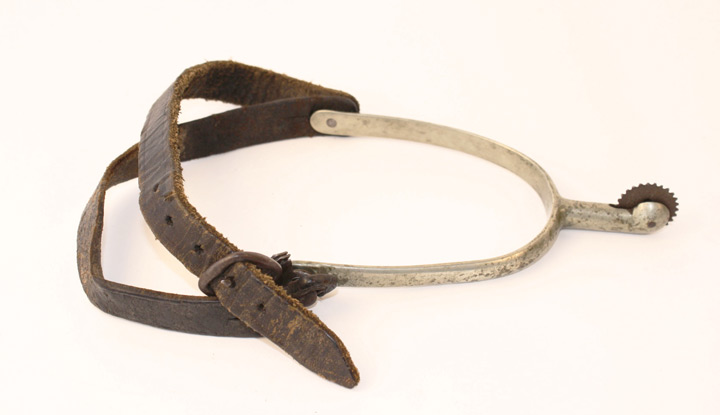
Metal Piece Length:12cm
Larger Image