
Urine Pots, Medieval-Tudor, Replica
Description
Urine is a human waste product that we flush away several times
every day. A complicated plumbing system of toilet bowls, pipes,
flowing water and cleansing methods ensures that urine is
efficiently removed from our homes and does not pollute our
environment.
Urine had many uses in the past: It was used to soften leather in
the tanning (leather) industry, as a cure-all for medicinal
purposes, or to shrink cloth before being dried and sold, to name
but a few.
Urine was also very useful as a mordant to dye cloth. In the
medieval to tudor times clothes were made out of woven wool, flax
and silk. The fabrics were dyed with natural dyes taken from seeds,
leaves, flowers, roots and bark. A mordant is a liquid used to set
the dye when it colours the garment, preventing the colour from
running out when the garment was washed. Urine proved an excellent
mordant and, as many families dyed and made their own clothes,
urine pots were used to collect urine for the dyeing process. Pots
came in different shapes and sizes; in the north of England they
were larger due to the woollen industry requiring larger quantities
of urine.
These urine pots are made out of clay, hand thrown and then the
green glaze applied. Each pot has a different handle, attached to
the pot before firing using a mixture of clay and water called
slip, as a glue. The openings of each pot are different, but are
small enough to protect the carrier from both splashing and the
smell of stale urine. The pots hold 1 pint (568 ml) of urine each,
and can be held, even if full, with one hand.
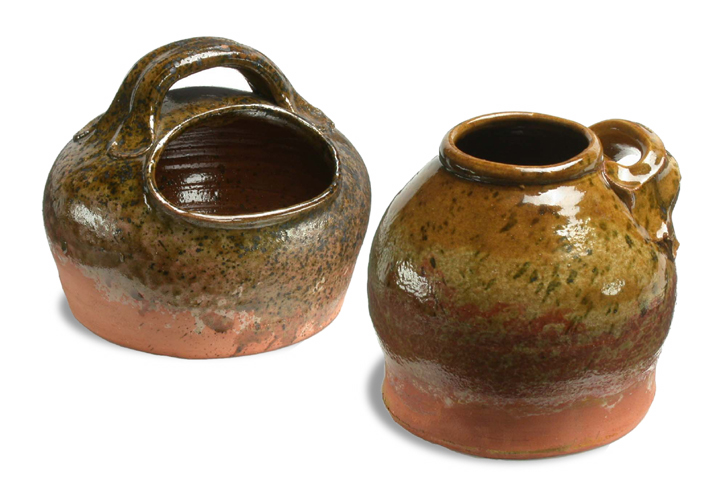
Right-hand base diameter:14cm Mouth diameter:2.5cm
Read More
The Tudors did not have flush toilets and plumbing. Houses had no
proper drains, so dirty water and other rubbish, including urine,
was thrown into the street or into the nearest river. Because of
this, there were many outbreaks of disease, often deadly. Some
wealthy Tudors had houses with a garderobe chute, to dispose of
urine and faeces. The garderobe was a small room with a wooden seat
placed over a chute on the outside of the house. The wooden seat
had a hole onto which you would sit. Toilet waste was collected
outside the house and used on the garden. Some poorer households
used an outdoor latrine. Chamber pots in the bedroom meant people
did not have to go outside at night.
The urine pot, or urinal on the right is a replica of one made in
or near London. There were many kiln sites on the Hampshire/Surrey
borders, in Essex and St Albans in the Tudor period. Urine pots
were a common product in the repertoire of a successful pottery,
along with pitchers, cooking pots, bowls, bottles, jugs and dishes.
Many were produced with a thick green glaze. Tudor pots were
usually fired in kilns. Some kilns were semi-permanent, created by
covering a collection of pots with peat or wood and leaving them to
burn for a set period of time. Other kilns were stone structures
with a stoke pit to contain and control the heat.
During the Tudor period England became a major trading centre.
Products from around the country were gathered in London for
export. Lancashire and Norfolk were the chief providers of woollen
cloth, and Manchester and Halifax were important centres of the
cloth industry. New developments, such as the invention of the
spinning machine, speeded up the process of making cloth and
clothes. Dyeing was an important part of this industry. Boys could
chose to be apprenticed to a number of trades, including soap
makers, tanners, rope makers, and dyers. The finest clothes were
made out of linen, silk and wool cloth. These were dyed
professionally to create coloured fabrics for doublets, jerkins,
sweeping skirts and bodices. Working people needed more practical
clothes, and wore loose fitting shirts, tunics and leggings that
they wove themselves. These were made from wool cloth and dyed blue
or brown with vegetable dyes. Dyeing was both a trade and an
essential domestic craft. Urine was a useful commodity for these
dyers.
Right-hand base diameter:14cm Mouth diameter:2.5cm
Larger Image