
Utility Dress, 1940s, Original
Description
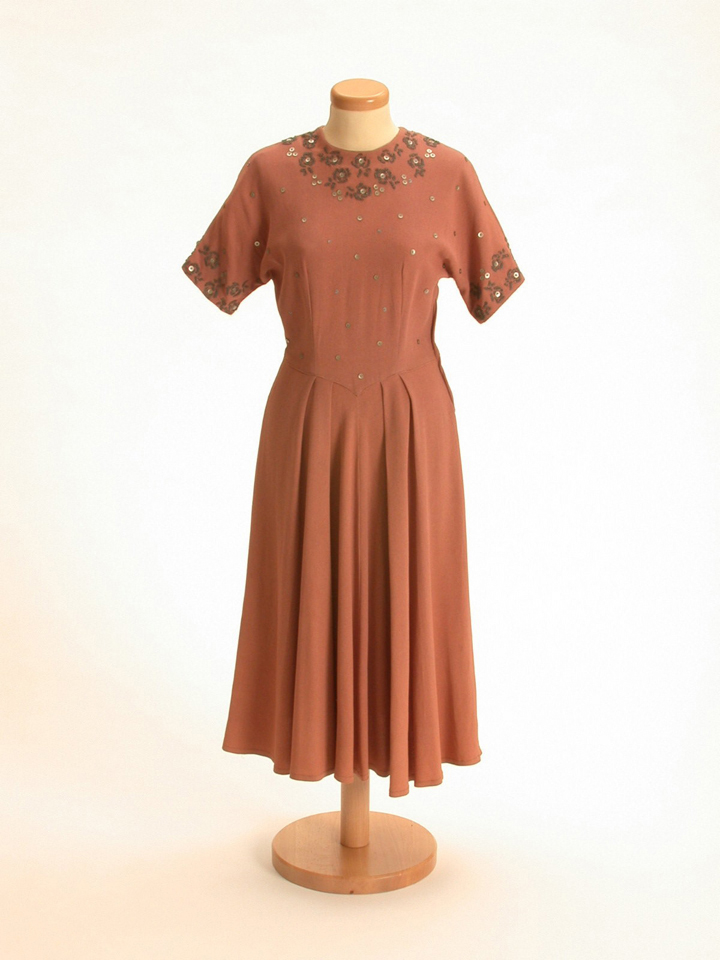
Even in wartime there was still time for dinner, dancing and other
special occasions; time for the 1940s woman to get dressed up and
go out on the town. This elegant dress is dusky pink and made from
polyester with sequins and embroidered flower details. It was worn
in the daytime, or in the evening with a jacket or coat, and a hat.
This dress is simple and plain in design, with a round neck,
slightly gathered waist and a calf-length skirt.
This dress is called a Utility Dress because it was made under the
Utility Scheme. This scheme was introduced in 1941 when the British
Government rationed clothes. Since there was less fabric available,
clothes had to be simpler and plainer in design. The government
provided clothes patterns to tailors and factories to make clothes
that followed their rules. The rules limited the amount of fabric
that could be used, along with a limit on the number of buttons,
pleats and pockets.
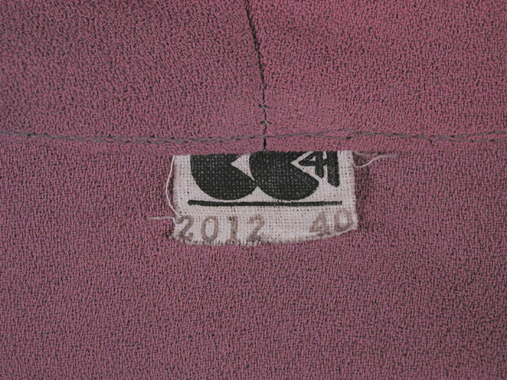
Inside the dress is the label ‘CC41CC41 – Civilian Clothing 1941 – symbol on label of clothes designed by London fashion designers under the Utility Scheme. The designs followed rules about the amount of material and trimming that could be used.‘ which stands for
Civilian Clothing 1941. This shows that the dress was from a
government-approved pattern in 1941. The government involved famous
fashion designers to make the Utility designs popular. Hardy
Amies1909- 2003 – London fashion designer who had his own fashion house and designed clothes for the government's Utility Scheme during WWII. He was famous for understated tailoring and regal ball gowns, and became the royal dressmaker in 1948. and Norman Hartnell1901-79 – London fashion designer who had his own fashion house and designed clothes for the government's Utility Scheme during WWII. Notably, he became the royal dressmaker in 1938 and designed Queen Elizabeth's Coronation gown. were among those 1940s
designers who created streamlined and stylish dresses with the CC41
Utility Mark.
This dress was worth 7 clothing coupons in wartime. (A coat was
worth 14, while a pair of socks was 1 coupon.) In 1941, each person
had 66 coupons for the year.
Alternative view
Read More
During World War IIThe Second World War (1939-45) fought between the Allies (France, the Soviet Union, Britain, Australia, Canada and the USA) and the Axis (Germany, Italy and Japan)., Britain had a shortage of fabric for
ordinary, civilian clothes. Factories abroad had to cut down on
producing fabric as they concentrated on the war and its needs. The
fabric that was brought over in boats often did not make it safely
to Britain. Cargo ships were easy targets for enemy attacks and
were frequently torpedoed by submarines. So Britain had to rely on
its own production of cloth. Scarce cloth was earmarked for making
service uniforms, camouflage gear, parachutes and other military
items.
The government thought that the best solution to the material
shortage was to ration clothes, and to make the design of the
clothes as trim and economic as possible. The Utility Clothes were
simple, practical and did not waste precious fabric. Women’s skirts
were short and narrow. Blouses were tight and short sleeveless
jumpers were common. Jackets were short too, with a maximum of
three buttons and a single-breasted collar. Clothes were not
supposed to have decorations like embroidery, a row of buttons or
an extra pocket. Only buttons, pockets, pleats and stitching that
were necessary were allowed.
Women’s fashions fell in with the rules about Utility Clothes.
Styles that were popular before the war became unfashionable. Wide
skirts, double-breasted jackets, large cuffs, velvet and fur
trimming, and trousers with turn-ups were seen as wasteful and
unpatriotic. The new fashion was for an austere silhouette with no
adornments. Lines were simple and straight. Military style suits
were popular with women throughout the war. They wore boxy jackets,
with padded shoulders and narrow waists, and straight skirts that
rose to the knee.
This dress was suitable for smart day or evening wear. It may have
been kept for special occasions. During the war many women worked
in factories, in the services or in voluntary organisations, where
they did hard physical jobs like making gas masks or patrolling the
streets as ARP wardens. Women’s work clothes were often
either uniforms or overalls, which were hard wearing and long
lasting. It is unlikely that this dress would have been worn to
work. Instead, the owner would have donned it for dinner, dancing
or even to get married.
During the war fashions favoured practical clothes that allowed
women to move around freely. The wedge shoe, turbanHead-covering consisting of a long piece of cloth wound around the head., siren
suit and kangaroo cloak were some of the most fashionable and
practical clothes of the time. The wedge shoe with a cork sole was
clumpy but comfortable and women could walk long distances in them.
The turban stopped hair from getting in the way of factory work and
housework and let women hide their ‘bad hair days.’ The siren suit
was the original jump suit, an all-in-one outfit with a zip up the
front. It was convenient for work and warm in draughty situations
since it had no gaps. When the air raid siren went off in the
middle of the night, it was quick and easy to put on. That is how
it got the name ‘siren suit’ and people often wore this one-piece
in the air raid shelterPlaces where people took shelter during an air raid, such as underground stations, train stations, basements and Anderson shelters in the garden.. The kangaroo cloak was another
practical favourite because it had roomy pockets to carry essential
items. In dashing out to the air raid shelter, the wearer could
carry a torch, their identity card and gas mask in the pockets.
Larger Image
Glossary
- Air raid shelter
- Places where people took shelter during an air raid, such as underground stations, train stations, basements and Anderson shelters in the garden.
- CC41
- CC41 – Civilian Clothing 1941 – symbol on label of clothes designed by London fashion designers under the Utility Scheme. The designs followed rules about the amount of material and trimming that could be used.
- Hardy Amies
- 1909- 2003 – London fashion designer who had his own fashion house and designed clothes for the government’s Utility Scheme during WWII. He was famous for understated tailoring and regal ball gowns, and became the royal dressmaker in 1948.
- Norman Hartnell
- 1901-79 – London fashion designer who had his own fashion house and designed clothes for the government’s Utility Scheme during WWII. Notably, he became the royal dressmaker in 1938 and designed Queen Elizabeth’s Coronation gown.
- Turban
- Head-covering consisting of a long piece of cloth wound around the head.
- World War II
- The Second World War (1939-45) fought between the Allies (France, the Soviet Union, Britain, Australia, Canada and the USA) and the Axis (Germany, Italy and Japan).